

If you’re searching for a ShipBob alternative, you’re probably in one of two situations: a 3PL partnership that no longer fits your business, or the realisation that outsourced fulfilment margins no longer stack up. ShipBob is an outsourced 3PL provider: it stores and ships your stock in its own warehouses. The alternative you choose depends on which path makes sense for your operation.
We’ll walk you through the real alternatives: other 3PL providers if you want to stay outsourced, and Lagerverwaltungssoftware if you’re ready to bring fulfilment in-house or run your own 3PL operation. The best ShipBob alternative is different for high-volume sellers, Amazon-led brands and businesses running their own warehouses, and this guide covers all three.
| Anbieter | Typ | Am besten für | Multi-Client/3PL | Cloud-nativen |
|---|---|---|---|---|
| Clarus WMS | Lagerverwaltungssoftware | 3PL-Anbieter und Distributoren, die ihre eigenen Betriebe führen | Ja, native Trennung der Bestände für mehrere Kunden | Ja, Serverless |
| ShipMonk | 3PL-Fulfillment | E-Commerce mit hohem Umsatzvolumen, DTC-Marken | Nein | Ja |
| Shipfusion | 3PL-Fulfillment | Amazon-Verkäufer, Multi-Channel-E-Commerce | Nein | Ja |
| Red Stag Fulfillment | 3PL-Fulfillment | Verkäufer im mittleren Preissegment, zerbrechliche Waren | Nein | Ja |
| GoBolt | 3PL-Fulfillment | Lieferung am selben Tag oder am nächsten Tag innerhalb Großbritanniens | Nein | Ja |
| Amazon Multi-Channel-Fulfillment (MCF) | 3PL-Fulfillment | Amazon-Verkäufer, die von Amazon betriebene Zentren wünschen | Nein | k. A. (von Amazon betrieben) |
| Deposco | Lagerverwaltungssoftware | Kleine bis mittelgroße 3PL-Anbieter und Distributoren | Ja, Multi-Client | Ja, Cloud |
| Extensiv (3PL Central) | Lagerverwaltungssoftware | 3PL-Anbieter mit bestehender Infrastruktur | Ja, Multi-Client | Wolke |
Was ist ShipBob?
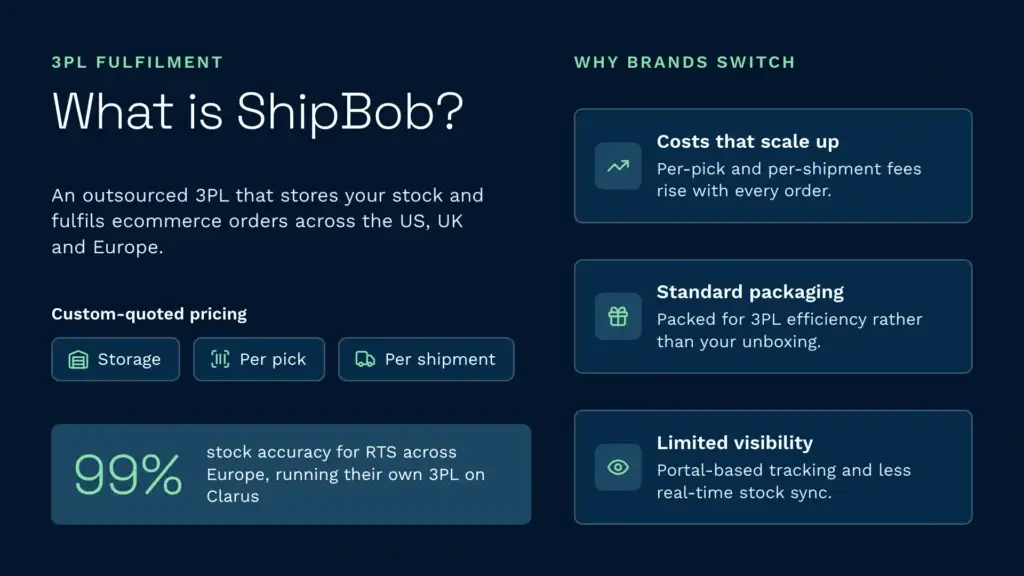
ShipBob is an outsourced 3PL fulfilment provider with fulfilment centres in the US, UK, Europe, Canada and Australia. It handles receiving, storage, picking, packing and shipping for ecommerce brands. The model is simple: you send it your inventory, it stores it, and it fulfils orders as they arrive. For an outside view of how well that works in practice, G2’s ShipBob alternatives page und Gartner Peer Insights both carry verified user reviews alongside the vendors buyers most often compare it with.
How much does ShipBob cost?
ShipBob doesn’t publish fixed rates. Its Preisseite für Großbritannien says each quote is tailored to your business, based on things like order volume, SKU count and storage needs. The quote is built from receiving fees, storage, fulfilment and shipping charges, with extras such as kitting, B2B orders and returns processing charged on top. Most 3PL pricing follows a similar pattern: storage per bin, shelf or pallet per month, receiving charges, fulfilment fees per order and per-parcel shipping costs. A low headline rate can hide per-order and add-on fees that compound as you scale.
Warum Marken ShipBob zugunsten von Alternativen verlassen
Three patterns come up again and again with ecommerce teams that decide to move.
Costs that scale with every order. Fulfilment and shipping charges grow in direct proportion to how much you ship, so the faster you grow, the faster that line grows with you. We won’t put a number on where it starts to hurt, because that depends on your margins rather than a published threshold.
Einheitliche Verpackung und Markenerlebnis. A 3PL serving many brands is set up to pack efficiently across all of them, which limits how far it can go for any one brand. For DTC brands, unboxing is part of the customer experience. If your brand identity depends on custom packaging, branded packing materials or handwritten notes, outsourcing to a general 3PL (rather than a bespoke co-packing partner) will always be a compromise.
Lücken bei der Unterstützung und Sichtbarkeit. 3PL support is usually transactional: you report an issue, they log it, you wait. Real-time visibility into inventory levels, pick, pack and ship status, and exception handling is limited. If your customers expect tracking transparency or you need live inventory sync with your sales channels, generic 3PL portals often fall short. Running your own operation gives you much tighter control. Echtzeitstrategie, a 3PL running its own warehouse network across Ireland, the UK and mainland Europe, reached 99% stock accuracy on Clarus. That’s the kind of figure you can only hold when the stock records are yours.
Die beiden Wege: 3PL-Alternativen vs. internes WMS
The best ShipBob alternative depends on the problem you’re actually trying to solve.
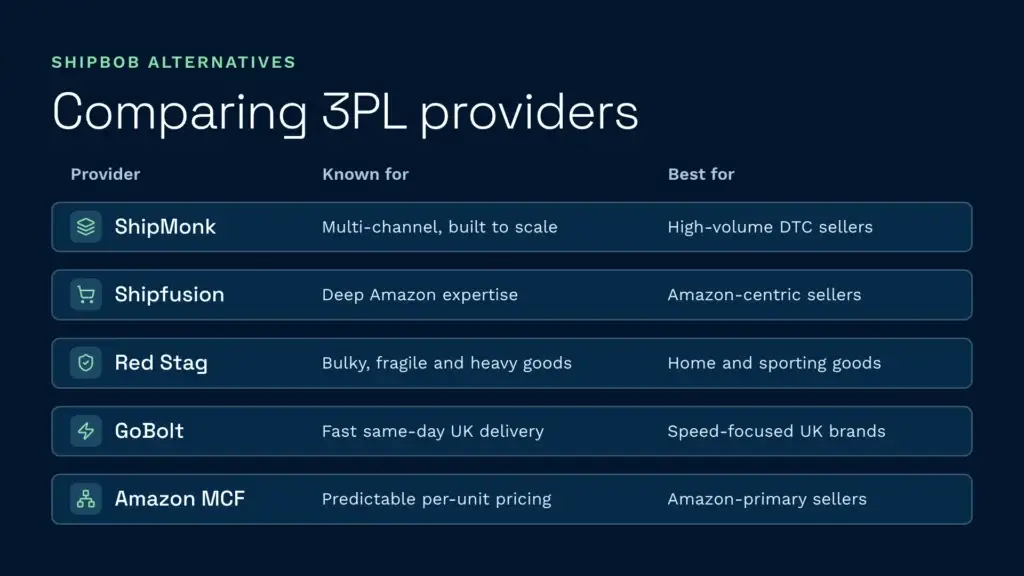
Möglichkeit 1: Sie möchten einen anderen 3PL-Anbieter. If outsourced fulfilment is still the right model, the real alternatives are other 3PL operators. ShipMonk, Shipfusion, Red Stag and GoBolt are among the names that come up most often in ecommerce circles, and each has its own niche. ShipMonk serves DTC, B2B and marketplace sellers. Shipfusion targets high-volume DTC brands and positions itself directly against ShipBob. Red Stag specialises in big, heavy and bulky goods. GoBolt combines fulfilment with its own last-mile delivery across Canada and the US. All of them quote custom pricing, so a true comparison means getting on calls with each one.
Path 2: You’re ready to bring fulfilment in-house or run a 3PL yourself. This is where warehouse management software comes in. A WMS isn’t a 3PL. It’s the software that runs warehouse operations: receiving, putaway, picking, packing, despatch and billing. Clarus WMS is built for 3PLs running multi-client operations, and for distributors or ecommerce brands ready to manage their own warehouses. If that’s the path you’re weighing up, our guide to the Das beste WMS für 3PL-Anbieter compares the software options on their own terms. The advantage is control: your SLAs, your branding, your pricing structure and, most importantly, your margins. Past a certain volume, in-house fulfilment or running your own 3PL can become cheaper than outsourcing, because your costs stop scaling one-for-one with your order count. Our breakdown of Was ein WMS kostet behandelt die Faktoren, die Sie berücksichtigen müssen, um herauszufinden, wo Ihre eigene Frequenzweiche liegt.
Alternativen zu ShipBob: Vergleich von 3PL-Anbietern
ShipMonk. ShipMonk is a US-based 3PL for DTC ecommerce brands, with B2B and marketplace fulfilment (including FBA and Prime) alongside. Its network is built to reach most of the US within two days, with expanding coverage in Europe. Strengths: multi-channel support, B2B as well as DTC, and investment in warehouse automation. Weaknesses: storage costs can add up for slow-moving or bulky SKUs. Best for growing DTC and marketplace sellers selling mainly into the US. Not built for running a 3PL operation: it’s a 3PL, not software for your own 3PL.
Shipfusion. Shipfusion positions itself as a direct alternative to ShipBob and owns and operates its warehouses in the US and Canada. Its main focus is high-volume DTC brands, with Amazon FBA prep and returns available for sellers who also use Amazon. Strengths: owned warehouse network and a clear switching process for ShipBob customers. Weaknesses: North American coverage only. Best for DTC brands selling into the US and Canada who want a like-for-like move away from ShipBob.
Red Stag Fulfillment. Red Stag has built its reputation on big, heavy and bulky products, from two US sites in Tennessee and Utah. It also covers D2C, retail, B2B, kitting and Amazon fulfilment. Strengths: specialist handling where damage risk is high. Weaknesses: pricing reflects that specialisation, and it serves the US only. Best for home goods, fitness equipment and other bulky products selling into the US.
GoBolt. GoBolt is headquartered in Toronto and runs its own network of fulfilment centres plus last-mile delivery across Canada and the US. Strengths: fulfilment and delivery under one operator. Weaknesses: coverage is North American. Best for brands selling into Canada and the US that want one partner from warehouse to doorstep.
Amazon Multi-Channel Fulfilment. If you already sell on Amazon, Multi-Channel Fulfilment lets Amazon pick, pack and ship orders from your other channels using stock already in its fulfilment centres. Advantages: access to Amazon’s logistics network, unbranded packaging, a single fee for pick, pack and ship, and integrations with Shopify, BigCommerce and others. Disadvantages: you’re limited to Amazon’s service levels, there’s no custom packaging, and you’re tied to Amazon’s infrastructure. Best for Amazon-first sellers who don’t need branded packaging.
WMS alternatives if you’re bringing fulfilment in-house
A warehouse management system is software that controls the movement and storage of stock in your warehouse. It runs receiving, picking, packing, returns and inventory. Unlike a 3PL, a WMS doesn’t physically store or ship your goods. It directs the people and systems that do. If you own a warehouse or operate a 3PL, you need one.
Clarus WMS. Clarus is built for 3PL and multi-client operations, which is why it sits at the top of this list for companies ready to run their own logistics. It’s cloud-native, so there are no servers to maintain. Each client’s stock, reporting and billing are kept separate within one system, and clients can see their own stock, orders and tracking through a branded portal. Automatisierte Rechnungsstellung records every putaway, pick, pack, storage day, value-added service and return as the work happens, with no manual re-keying.
St John's Hall Lagerung cut its invoicing time by 90%. Its managing director used to spend around four days at the end of every month checking invoices by hand, and stopped once the Clarus data proved consistently accurate. Clarus Preise starts from £1,000 a month for the Core plan, plus a one-off implementation fee and tiered user licensing, and it’s published rather than quoted on application. Integrations cover the UK carriers you’d expect, including Königliche Post, DPD, Evri und DHL, alongside ecommerce platforms and marketplaces such as Shopify, WooCommerce, Amazon und eBay.
An API covers anything custom, and the Vollständige Liste der Integrationen is public. The KI-Assistent reads operational data and acts on it: quarantining expired stock, generating stock transfer tasks from picking rates, and catching missed pallet charges across customer accounts. Honest fit: Clarus isn’t the answer for a small single-brand webshop, or for a parcel-only B2C operation where a fulfilment partner makes more sense. It’s for 3PLs, multi-client distributors and ecommerce operations running their own warehouses, often across several sites.
Deposco. Deposco is a cloud-based WMS used by ecommerce, retail, wholesale and 3PL businesses. Pricing is custom-quoted. Deposco says customers can be live in 90 days or less, so ask for that in writing against your own scope. Our Deposco alternatives guide compares it in more detail.
Extensiv (3PL Central). Umfassend, formerly 3PL Central, builds warehouse management software for 3PLs. Strengths: a strong presence in the US market, a broad feature set for complex 3PLs and a large customer base. Things to check: products are sold separately (3PL WMS, Billing Manager, Smartscan, Small Parcel Suite and more), and pricing isn’t published, so make sure your quote covers everything you need. Best for established 3PLs, particularly in the US. Our 3PL Central alternatives guide covers the comparison for UK 3PLs.
So wählen Sie die richtige ShipBob-Alternative aus
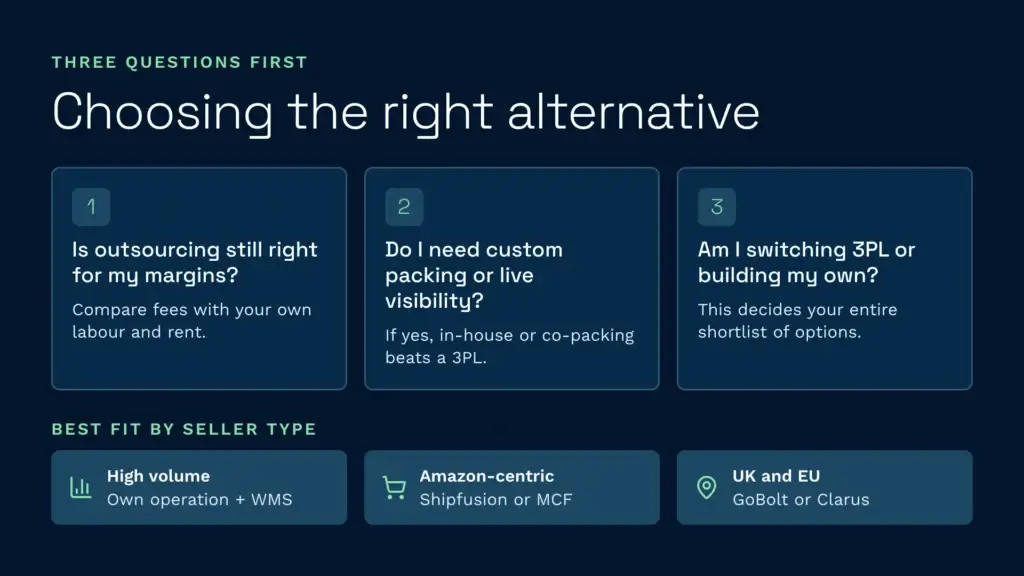
Stellen Sie sich zunächst drei Fragen.
- Is outsourced fulfilment still the right model for my margins? At what order volume do fulfilment and shipping fees exceed what you’d pay in salaries, rent, equipment and software for your own operation? That crossover is real, but it’s specific to you, and anyone who quotes you a universal order number for it is guessing. Build the comparison from your own labour rates and local rent, then check it against a vendor’s published pricing rather than an estimate.
- Do I need custom packaging, brand experience or real-time visibility? If yes, in-house or a bespoke co-packing partner beats a standard 3PL. If you’re happy with generic packing and can live with portal-based visibility, a 3PL alternative is fine.
- Am I switching 3PL providers or building my own operation? This decides the whole shortlist. Staying with a 3PL means evaluating ShipMonk, Shipfusion, Red Stag and GoBolt. Building in-house means evaluating WMS software: Clarus, Deposco or Extensiv. They aren’t comparable: one is a logistics service, the other is software that runs logistics.
Für Verkäufer mit hohem Absatzvolumen. The higher your volume, the stronger the case for running your own operation. A monthly licence behaves very differently from per-order pricing once your volume climbs, because it stops tracking your growth. Ask any vendor you shortlist for an implementation timeline in writing against your own go-live date, and hold them to it.
Whichever path you take, your stock data has to stay in step with the places you sell. That’s a separate problem from who picks the box. Our guide to Bestandsverwaltungssoftware für den E-Commerce Das wird darin behandelt, ebenso wie in unserer Übersicht über Versandmanagement-Software für die Netzbetreiberseite.
For Amazon-first sellers. Amazon MCF if Amazon is your main channel and you want your other channels fulfilled from the same stock. If you’d rather keep DTC fulfilment with a dedicated 3PL, Shipfusion and ShipMonk both offer Amazon FBA prep or marketplace fulfilment alongside it.
Für Verkäufer aus Großbritannien und Europa. Check coverage before anything else. ShipMonk, Shipfusion, Red Stag and GoBolt are mainly North American, while ShipBob and Amazon MCF both run UK operations. If you’d rather run your own operation across the UK and Europe, Clarus is built for that. Echtzeitstrategie runs its 3PL network across Ireland, the UK and mainland Europe on Clarus.
Sprechen Sie mit einem Lagerfachmann
One thing worth asking any WMS vendor early is how long they’ll actually take to get you live, because that gap is where a lot of in-house projects lose their business case. Mathew Buttar, Head of Solutions at Clarus, puts our own standard at 12 weeks, and he’s clear about why it isn’t shorter: “12 weeks is a good standard because you need to allow people time.” That assumes a standard project with the right support on both sides and no bespoke development.
If you’re weighing up your options and want to see how a purpose-built WMS works in practice, Clarus is worth a conversation. We work with 3PLs and distributors across the UK to implement warehouse management software that fits the way you operate.
Kontaktieren Sie unser Team um Ihre Anforderungen zu besprechen.