

An automated storage and retrieval system, usually called an AS/RS, is equipment that puts loads into racking and takes them out again without anyone walking the aisles to find them. Cranes, shuttles, lifts or carousels move under computer control to the stored location and bring the load back to a pick point or dispatch area. In a warehouse, the machines handle the physical movement, while a warehouse management system (WMS) keeps the stock records, decides where stock should go and tracks each order through to despatch.
The sector is covered by the Material Handling Institute’s ASRS Industry Group, and the general background is on Wikipedia. This guide explains the main equipment types, how a site runs with one, when it makes sense and when it does not, and what the software has to do around it.
What is an automated storage and retrieval system?
An AS/RS is a combination of racking, storage machines and control software. The racking holds the loads, the machine moves between the locations, and the control layer tells the machine what to fetch and when. You will also see it written as an ASRS system, an automated storage system or an automated pallet storage and retrieval system. In most conversations these mean the same thing, although a pallet system is only one type within the wider category.
The Material Handling Institute publishes an overview of AS/RS that describes the main equipment families, and its ASRS 101 article is a plainer introduction for anyone new to the subject.
What are the types of AS/RS?
Most systems fall into a small number of families, and the load unit usually decides which one fits. Pallets, totes, cartons and small trays each need different handling, so start with the load before you look at the machine.
| Typ | Load unit handled | Typical use |
|---|---|---|
| Unit-load crane (fixed or moveable aisle) | Full pallets | High-volume pallet storage across many locations |
| Pallet shuttle or satellite system | Pallets in deep lanes | Dense storage where each lane holds one product |
| Mini-load crane | Totes, cartons or trays | Piece picking, spare parts and small items |
| Tote or case shuttle | Totes or cases in lanes | High-throughput handling of case-level stock |
| Vertical lift module | Trays or bins | Small parts held in a compact footprint |
| Horizontal or vertical carousel | Bins or trays | Bringing small items to the operator at a fixed height |
| Cube storage | Bins stacked in a grid | Very dense storage of small items served by load handlers |
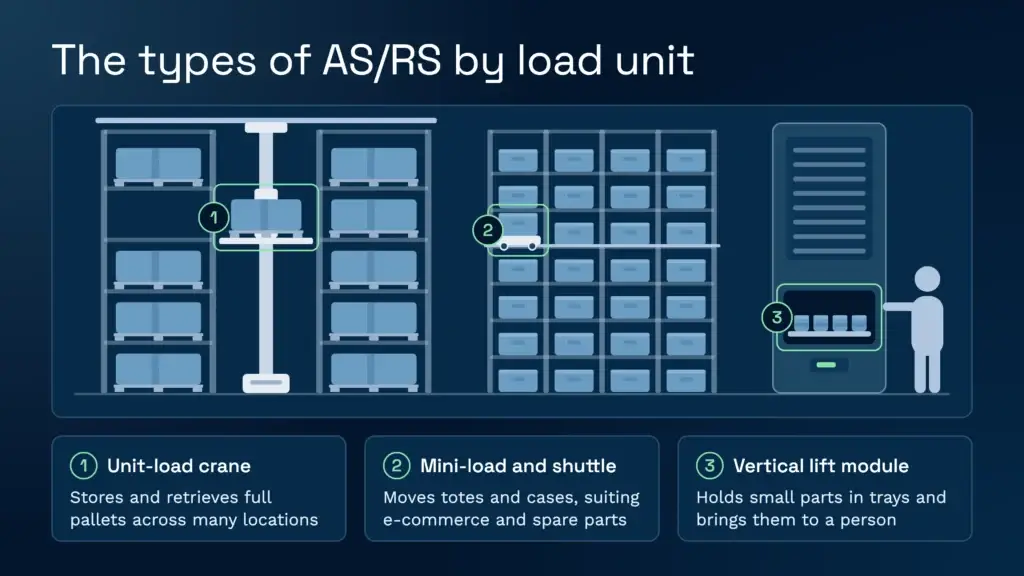
Unit-load cranes are the classic pallet system. Pallet shuttles serve deep lanes, which packs more pallets into the same footprint. That density works best when each lane holds one product, because the last pallet in is the first one out. Mini-load systems and shuttles handle totes and cases, which suits e-commerce and spare parts. Vertical lift modules and carousels bring small items to a person, so the operator does not walk the racking. ASRS racking is built to the machine’s tolerances, so the racking and the equipment are usually specified together.
Robot-based systems that move shelving or totes to people are a separate route, covered in our guide to Roboter in der Lagerlogistik.
What does an AS/RS do in a warehouse, step by step?
The workflow is much the same whatever the machine type. Every stage changes the stock record, and that is where the WMS earns its place. For the general storage process, see our guide to the warehouse storage process.
- Wareneingang. Stock is checked against the delivery and each load is given an identity. Unannounced deliveries are common, so the receiving step needs a route for loads that arrive without a booking as well as those that do. Our goods-in guide covers the receiving steps. In Clarus, each Palette gets its own storage unit reference, which stays with it from receipt to dispatch.
- Preparation for storage. Loads are checked for damage and labelled. A damaged load should be dealt with before it enters the racking, not after it has been stored.
- Automated putaway. The WMS selects a suitable location, and an instruction goes to the storage equipment through the control layer. The machine places the load and the record is updated.
- Retrieval. An order or replenishment request triggers a fetch. The machine brings the load to a workstation or pick point.
- Order assembly. The operator takes the required quantity at the workstation. Handheld scanning in Clarus checks each item against the order line, so a wrong item is caught at the workstation rather than at the customer.
- Packing and despatch. Packed orders are scanned out, the stock record is reduced and the despatch is recorded.
Each stage depends on the stock record matching what is physically in the store. When a load moves without a confirmed transaction, the system and the floor disagree, and that is the usual route into the stock errors covered later in this guide.
When is an AS/RS worth it, and when is it not?
An AS/RS suits a site where space is the constraint, the product range is fairly stable and order volumes are steady enough to keep the equipment busy. It is worth a serious look when staff spend a large share of their time walking to locations, or when extending the building is not an option. Manufacturers holding raw materials and components use AS/RS for the same reasons.
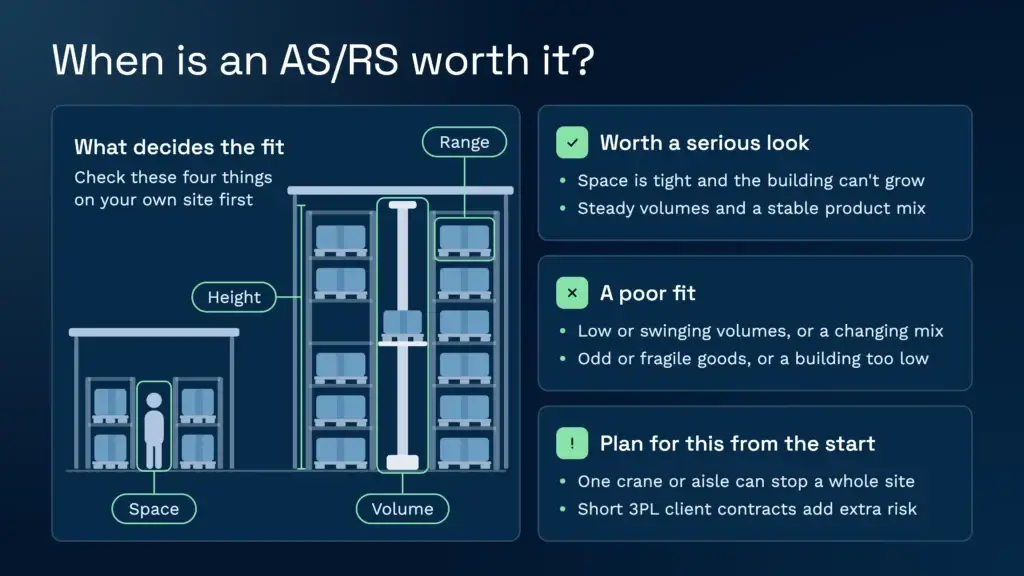
It is a poor fit where volumes are low or swing sharply, where the product profile changes often, where goods are oversized, irregular or fragile, or where the building is too low to use the height the machines need. Two points deserve more weight than they usually get. First, a single crane or aisle can stop the flow of a whole site, so downtime plans matter from the start. Second, a 3PL on short client contracts is carrying equipment whose cost has to be recovered from clients who may leave.
Mathew Buttar, Head of Solutions at Clarus, who was a warehouse and operations manager before moving into WMS implementation, puts the payback test simply: “Unless you know you’ve got the volume over a 10-year period, for example, that’s going to pay back your automation.” That is his view of when the long-run volume case has to be proven. It is not a benchmark for any site.
How much does an automated storage and retrieval system cost?
Costs vary by type and scale, so no single figure would be fair across a pallet crane and a small carousel. Figures in the published literature are often dated, which is why this guide does not quote one. The main cost drivers are:
- Ausrüstung: the machines and their drives, controls and safety devices.
- Racking and building works: the racking itself, floor and height works, and any changes to the building.
- Software and integration: the WMS, the control layer and the interfaces between them.
- Installation and commissioning: fitting, testing and proving the system before it takes live stock.
- Ausbildung: operators, supervisors and the super users who will support the system after go-live.
- Maintenance and energy: service contracts, spares and the power the machines draw.
When you ask for proposals, request the price split under those headings. That makes the comparison fair and shows where the real cost sits. For a review of how these systems have been modelled and costed in research, see the survey of literature on automated storage and retrieval systems by Roodbergen and Vis in the European Journal of Operational Research (2009).
Does an AS/RS replace a WMS?
No. The machines move the loads, but they do not decide which stock belongs where, whose stock it is, or whether an order is complete. The WMS holds those rules and the stock records. Definitions differ between suppliers and sites, but broadly a warehouse control system (WCS) directs equipment in real time, and a warehouse execution system (WES) coordinates work across the operation. For the different types of WMS and how they differ, see our guide to Arten von Lagerverwaltungssystemen.
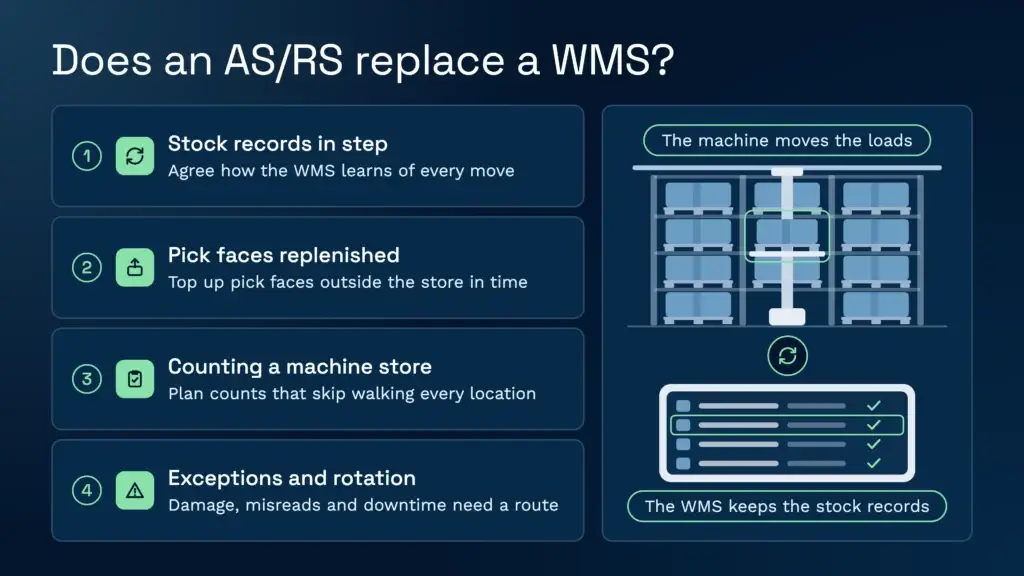
Clarus is a WMS. We do not make AS/RS hardware, so this section describes what the software has to do around a storage system, not a product we supply. Whichever suppliers are involved, four areas need agreeing up front:
- Stock records in step with the machine. Agree how the WMS learns about every movement the machine makes, and reconcile the two regularly. A load that moves without a record is the most common cause of a wrong location.
- Replenishment of pick faces. Pick locations outside the machine need topping up from the store in time for orders. Our guide to warehouse replenishment covers the demand-led approach. In Clarus, replenishment is driven by order demand and can also follow Verfallsdaten.
- Stock that nobody can walk up to. Counting a machine store needs a plan that does not depend on walking every location. Mathew Buttar’s preferred method is to count a sample of pallets each week and apply the error rate found to the rest of the store. Clarus has a guide to running structured stock checks. JODA Freight, a 3PL, moved its stock takes from weeks on Excel to one day in its customer story, and reached 99% stock accuracy by its second year.
- Exceptions and stock rotation. FIFO depends on when each stock record was created. In deep or bulk storage the oldest stock can sit at the back, so the rule works less well unless the system can take the nearest matching pallet instead. Clarus applies FIFO, FEFO and LIFO rules that can be set per client or per product. Damaged loads, mis-read labels, failed retrievals and machine downtime each need a defined route. Clarus uses automations, for example putting stock on hold when it is received into a quarantine location, so it cannot be allocated until it has been released.
What safety rules apply to automated storage?
Automated storage brings hazards of its own, including moving machines in aisles and loads at height. In the UK, HSE guidance HSG76 covers warehousing and storage. The Provision and Use of Work Equipment Regulations (PUWER) set the duties for work equipment, which covers automated handling equipment. The UK Warehouse Association (UKWA) represents warehousing operators across the UK.
Complete a risk assessment for each aisle and access point before the first load is stored, and agree how maintenance staff enter the system safely.
What should you decide before you talk to suppliers?
Suppliers will ask the same questions, so settle the answers first:
- Load units: pallets, cartons, totes or trays, with their weights and dimensions.
- Throughput: average and peak movements, and how many orders reach the store each day.
- Product profile: the number of SKUs, the stock held per SKU and how often the range changes.
- Storage conditions: ambient, chilled or frozen zones, and any hazardous or temperature-controlled areas.
- Building: usable height, floor condition and room for growth.
- Shifts and maintenance: the shift pattern and the window available for servicing.
- Future expansion: the volume and product changes you expect in the next few years.
Our guide to warehouse automation companies is a starting point for finding suppliers. Check each one against the list above before you shortlist.
Sprechen Sie mit einem Lagerfachmann
If you’re evaluating your options and want to see how a purpose-built WMS works in practice, Clarus is worth a conversation. We work with 3PLs and distributors to implement warehouse management software that fits the way you operate, not the other way around.
Kontaktieren Sie unser Team um Ihre Anforderungen zu besprechen.