

When you’re evaluating warehouse management software, the choice between Clarus WMS and Körber WMS (formerly HighJump, now part of Infios) comes down to one question: what does your warehouse actually need to do?
Both are capable warehouse management systems with multi-client support, but they’re built for different operational contexts. Infios is best known for enterprise deployments: large warehouses with significant investment in conveyors, robotics and labour management. Clarus is a 3PL-WMS built for multi-client warehousing, quicker deployment and published pricing.
This comparison is for 3PLs, distributors and mid-market warehouse operators weighing up their options. We cover cost, implementation speed, multi-client capability and feature depth, so you can make the right call for your operation.
Schnellvergleich: Clarus vs. Körber auf einen Blick
| Dimension | Clarus WMS | Körber WMS (Körber One) |
|---|---|---|
| Am besten für | 3PLs, mid-market distributors, 10 to 300+ users | Große automatisierte Lager, Logistiknetzwerke von Unternehmen |
| Cloud-Architektur | Serverlos, cloud-nativ; tägliche Updates, keine Ausfallzeiten durch Upgrades | „Cloud-first“ (Option für die lokale Installation verfügbar); versionsbasierte Veröffentlichungen |
| Unterstützung mehrerer Mandanten | Integriert; Bestandsaufteilung, kundenbezogene Abrechnung, Kundenportal inklusive | Verfügbar; erfordert ein zusätzliches Modul/ist komplexer |
| Zeitplan für die Umsetzung | Weeks, not quarters. Configuration-led. | A multi-month programme. Ask Körber to commit its date contractually. |
| Preismodell | Published tiers from £1,000/mo base, plus tiered user licensing and a one-off implementation fee. No throughput charges. | Not published. Enterprise pricing by quote, with multi-year terms typical. |
| 3PL-Abrechnungsautomatisierung | Echtzeit, automatisiert; erfasst jeden abrechnungsfähigen Vorgang (Wareneingang, Lagerung, Kommissionierung, Verpackung, Versand, Retouren) | Verfügbar; erfordert häufig eine individuelle Konfiguration und professionelle Dienstleistungen |
| Integrationsbibliothek | 200+ out-of-the-box (Shopify, WooCommerce, Sage, Brightpearl, 70+ carriers) | Über 500 Integrationen (SAP, Oracle, Azure, Schwerpunkt auf Unternehmens-ERP-Systemen) |
| Automatisierungsfunktionen | Kommissionierung nach Wellenprinzip, gezielte Einlagerung, Scan-Überprüfung, KI-Lagerassistent | Umfassendes WCS (Warehouse Control System) + WMS; Robotik, Fördertechnik, Personaloptimierung |
| Reaktionszeit des Supports | Sub-2-minute average | Gestaffelte SLAs; Unternehmensverträge als Standard |
| Kunden | Über 100 Standorte weltweit; vor allem 3PL-Anbieter und mittelständische Distributoren aus Großbritannien und den Benelux-Ländern | Über 1.600 weltweit; große Distributionszentren, stark automatisierte Betriebe, Einzelhandelsnetzwerke großer Unternehmen |
Fazit in einem Satz: Choose Clarus if you need a WMS built for multi-client 3PL operations, with published pricing and a go-live measured in weeks. Choose Infios if you’re running a large, automation-heavy distribution centre with an enterprise budget and a 4 to 8 month implementation window.
What is Körber WMS (now Infios)?
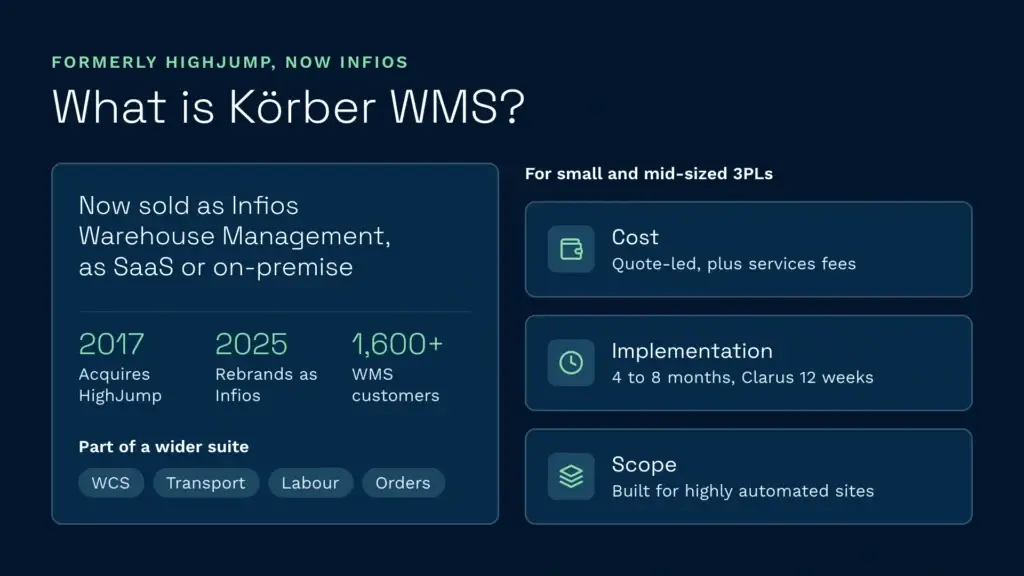
Körber WMS is the warehouse management system from Körber’s supply chain software business, which acquired HighJump in 2017. That business became a joint venture between Körber AG and KKR, and in March 2025 it rebranded as Infios. The product is now sold as Infios Warehouse Management, available as SaaS or on-premise, with 1,600+ WMS customers across the Americas, Europe and Asia.
Infios WMS sits within a wider supply chain execution suite that includes a warehouse control system (WCS), transportation management, order management and labour management. For large operations running significant automation (conveyors, sortation, robotic case picking), Infios can coordinate both the WMS and the physical equipment through a single control point.
What is it good for? Infios is strongest in large, labour-intensive warehouses with significant automation investment, where WCS integration is critical. It also has a 3PL offering with multi-client support, a built-in billing engine and a customer portal. For a small or mid-market 3PL, the full enterprise feature set is often more than you need, and the implementation timeline reflects that positioning.
Ist das Körber WMS für kleine und mittelgroße 3PL-Anbieter geeignet?
Technically, yes. Infios even markets a SaaS WMS for SMBs with ready-made NetSuite and SAP Business One connectors. In practice, there are three things a smaller 3PL should weigh up.
Cost. Infios doesn’t publish pricing, so you won’t know the figure until you’ve been through a sales cycle. Plan for the shape of it: a subscription or licence, a professional services engagement to tailor the implementation, and contract terms to negotiate. For a mid-market 3PL, that’s a procurement exercise rather than a software purchase, and it needs sign-off to match.
Implementation time. Infios says most implementations take around 4 to 8 months. A standard Clarus implementation goes live in around 12 weeks. If you’re a 3PL trying to win a contract and get operational before the client loses patience, that difference can decide whether you can bid at all.
Komplexität. Infios’s WCS, conveyor control, robotics orchestration and advanced labour management are valuable in a highly automated facility. If you’re a 3PL running several semi-manual warehouses across the UK, you’re paying for capability you won’t use.
Für wen diese Größe gut geeignet ist: A mid-market 3PL that’s planning significant automation investment (conveyors, sortation, automated storage and retrieval) and can treat a multi-month implementation as a capital project. If that’s you, Infios is worth evaluating alongside automation consultants.
Who it doesn’t work for: A 3PL that needs to deploy quickly, run several regional sites with different client needs, or replace spreadsheets without a long project plan. That’s where Clarus fits.
How does Clarus WMS compare to Körber on cost and implementation time?
Cost and go-live speed are where the two platforms separate most clearly, and also where public information runs out fastest. Here’s what can be verified, and what you’ll need to ask for.
Pricing and total cost of ownership
Clarus publishes its tiers. Plans start from £1,000 a month base across Core, Scale and Enterprise. A full quote adds tiered user licensing, where the cost per user falls as you scale, plus a one-off implementation fee for configuring your layout, cleaning SKUs and setting up courier logic. What it never adds is a throughput charge: orders, shipments, SKUs, stock records, locations and carriers are unlimited, so taking on a client or running a peak doesn’t move the invoice.
Infios doesn’t publish pricing, so nobody can build an honest like-for-like table from public information. Any five-year comparison you find online, including ones that flatter Clarus, is guesswork.
What you can do is make both vendors answer the same questions in writing before you compare anything:
- The subscription, and exactly what makes it go up: users, sites, throughput, or all three.
- Implementation and professional services, as a separate figure with a scope attached.
- Annual support and maintenance, and whether upgrades are included or chargeable.
- Contract term, notice period, and what it costs to leave.
Run that for both and the difference will be obvious without anyone having to invent a number. Our WMS cost guide covers what else to include. The structural point stands on its own: Clarus publishes a starting price and doesn’t bill on volume, and Infios quotes per deal.
Proof point: St John's Hall Lagerung, a 3PL, cut its invoicing time by 90% with Clarus 3PL billing. Its managing director used to spend around four days at the end of each month checking invoices by hand, and stopped once the Clarus data proved consistently accurate. Every putaway, pick, pack, storage day, value-added service and return is now recorded as the work happens, so nothing goes unbilled.
Umsetzungsgeschwindigkeit
A standard Clarus project goes live in around 12 weeks. Infios puts most of its implementations at 4 to 8 months.
The gap comes from the scope of the project rather than vendor effort. An enterprise deployment has to work through:
- Discovery and requirements workshops
- Data migration and master data clean-up
- Maßgeschneiderte Entwicklungs- und Integrationsarbeiten
- User training and change management
- Testing, UAT and cutover planning
- Go-live and a stabilisation period
Clarus is pre-built for 3PL operations, so most of the “customisation” is configuration: choosing existing workflows and features that already fit the typical 3PL model. Integrations use pre-built connectors to over 200 systems, and training is hands-on, with super users identified early so your own team owns the system after go-live.
For a 3PL, that difference is commercial, not technical. Signing a client in January and being live by spring is a bid you can win. A programme that runs most of the year means the client has to wait, and waiting is exactly what they’re trying to avoid by outsourcing to you. Ask any vendor to put its go-live date in the contract, then see which ones will.
Was ist für britische 3PL-Lager besser: Clarus oder Körber?
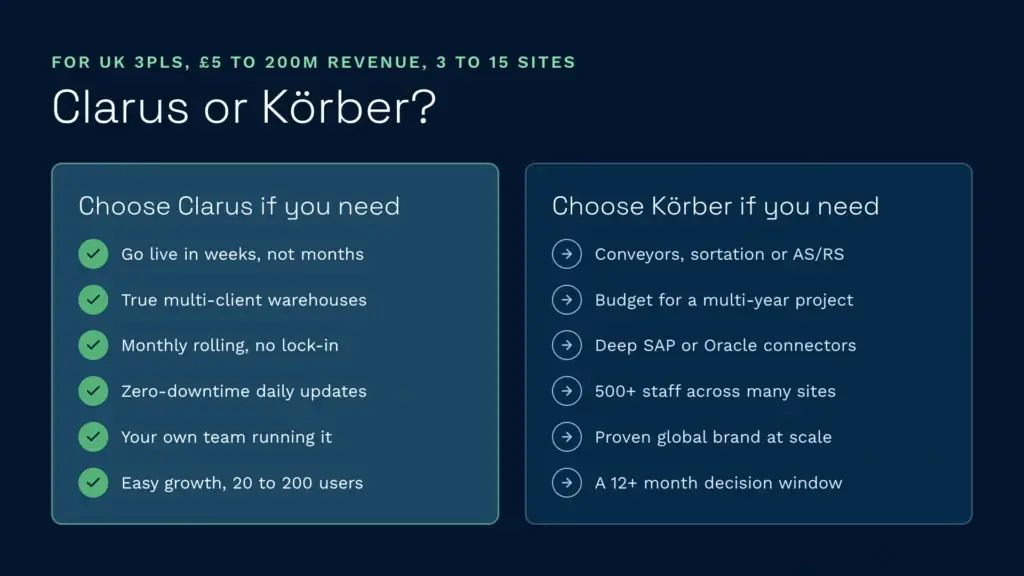
For most UK mid-market 3PLs running several regional sites with manual or semi-manual operations, Clarus is the better fit. Here’s the decision framework.
Entscheiden Sie sich für Clarus, wenn Sie:
- Need to go live in weeks rather than months. You’re replacing a legacy system or have won a new customer contract and can’t afford a long implementation.
- Run multiple clients in the same warehouse. Clarus is built for this, with each client’s stock, billing and branded portal kept separate.
- Want transparent, predictable pricing. Clarus publishes its starting price and doesn’t charge on throughput, so peaks and new clients don’t move the invoice.
- Have limited IT resources. Clarus is cloud-native, so there are no servers to maintain.
- Want your own team to own the system. Clarus is designed to be configured and run directly by your operation.
- Are growing fast and need flexibility. Adding users or sites is incremental, and the per-user cost falls as you scale.
- Don’t need advanced WCS capabilities. You’re not automating conveyors or robotics. You’re running standard putaway, picking and packing at human speed.
Choose Infios if you:
- Are planning significant warehouse automation (conveyors, sortation, automated storage and retrieval). Infios’s WCS is built for exactly this.
- Are a large enterprise with consolidated IT and budget for a major project. You can absorb a 4 to 8 month implementation and have the project management to see it through.
- Need integration with SAP, Oracle or other large ERP systems as a core requirement. Infios connects to ERP, labour, yard, transport and order management systems.
- Have a large logistics network and need enterprise-grade visibility, reporting and compliance across multiple sites and business units.
- Don’t need rapid deployment. Your decision window is long and you’re planning for a multi-year platform relationship.
Was ist eine gute Alternative zu Körber WMS für KMU?
If you’re a small or mid-market warehouse operator and Infios feels like more than you need, here’s where Clarus fits. Our guide to Körber WMS alternatives covers the wider field.
Für Schnelligkeit und 3PL-Fähigkeit im Multi-Client-Betrieb: Clarus WMS is built for exactly this job, with real-time 3PL billing, a client portal and published pricing.
Für Transparenz und Kostenkontrolle: Clarus pricing is published and doesn’t charge on throughput. User licensing is tiered, so the cost per user falls as you grow, and you can forecast the cost accurately.
Für die betriebliche Eignung: Clarus’s solutions team includes people who’ve run warehouses themselves. The workflows reflect real 3PL operations: multi-client stock segregation, complex billing rules, carrier integration and client-facing visibility.
Beispiel aus der Praxis: JODA Fracht went from stock accuracy in the 90 to 97% range in its first year on Clarus to 99% by year two. It didn’t need WCS features. It needed accurate inventory tracking and reliable client reporting, without the enterprise overhead.
Ein weiteres Beispiel: Mitchell Storage & Distribution (MSD), a 3PL, cut its admin workload by 60% and turned cross-docking for the Palletforce network into a reliable revenue stream, all on Clarus, at mid-market cost.
Vergleich der Funktionen und der Eignung nach Unternehmensgröße
Here’s how Clarus and Infios map to different warehouse sizes and levels of complexity:
| Unternehmensgröße / Szenario | Clarus-Passform | Körber-Passform | Die beste Wahl? |
|---|---|---|---|
| Single-site, 10 to 50 users, simple picking | Excellent. Live in weeks. Published pricing from £1,000/mo base. | Overkill. An enterprise programme, and you pay for automation capability you will not use. | Klar |
| 3PL, 5 to 10 sites, 50 to 150 users, multi-client | Ideal. Built for this. Multi-client and 3PL billing out of the box, client portal included. | Workable, but multi-client needs an additional module and the timeline is a multi-month programme. | Klar |
| Distributor, 3 to 5 sites, 100 to 200 users, complex picking rules | Strong fit. Wave picking, directed putaway, integration to Sage and Brightpearl, live in weeks. | Das funktioniert ebenfalls. Wenn Sie bereits SAP/Oracle einsetzen, lässt sich Körber gut integrieren. Allerdings ist dies langsamer und teurer. | Klar (es sei denn, Sie haben sich bereits für ein Unternehmens-ERP-System entschieden) |
| Großes 3PL-Unternehmen oder Distributionszentrum, über 200 Benutzer, hoher Automatisierungsgrad (Förderbänder, Sortieranlagen) | Das ist möglich, aber die WCS-Integration von Körber ist die bessere Wahl, wenn Sie in Förderanlagen investieren. | Eine perfekte Passform. Das ist Körbers Spezialgebiet. | Körber |
| Unternehmensweites Logistiknetzwerk, über 500 Nutzer an mehr als 20 Standorten, länderübergreifend | Clarus ist zwar skalierbar, konzentriert sich jedoch in erster Linie auf Großbritannien und die Benelux-Länder. Für eine wirklich globale Präsenz bietet Körber eine stärker regionsspezifische Unterstützung. | Hervorragende Eignung. In großem Maßstab in zahlreichen Ländern und Geschäftsbereichen bewährt. | Körber |
| Ersatz eines Altsystems innerhalb von sechs Monaten | Leistungsstark. Clarus wurde für den schnellen Austausch veralteter Systeme entwickelt. | Risikobehaftet. In der Regel beträgt die Laufzeit 12 Monate; bei verkürzten Zeitplänen kommt es zu chaotischen Zuständen. | Klar |
| Investitionen in die Lagerautomatisierung (Robotik, automatisierte Lager- und Kommissioniersysteme) | Kann dies unterstützen, allerdings ist die WCS-Integration keine Kernkompetenz. | Ideal. Die umfassende Koordination von WCS und WMS ist die Spezialität von Körber. | Körber |
Clarus WMS as the 3PL-focused alternative to Körber
If you’re looking at alternatives to Infios, it’s worth stepping back to look at what’s changed in warehouse software over the past few years.
Older WMS platforms, whether on-premise or early cloud, were built for an era when warehousing was centralised, labour-heavy and slow-moving. Upgrades were big events, implementations took the best part of a year, and customisation meant code changes. That model worked for very large enterprises, where a long cutover was a cost of doing business.
Modern 3PLs operate differently. You win a customer contract in Q1 and need to be live soon after. Your customers move between ecommerce platforms (Shopify, WooCommerce, Amazon), and your WMS has to keep up. You’re handling multiple billing rules per client, complex carrier integrations and clients who expect real-time visibility.
That’s the problem Clarus was built to solve: a WMS that’s quick to deploy, easy to change and transparent to run, with no charges tied to how much you ship.
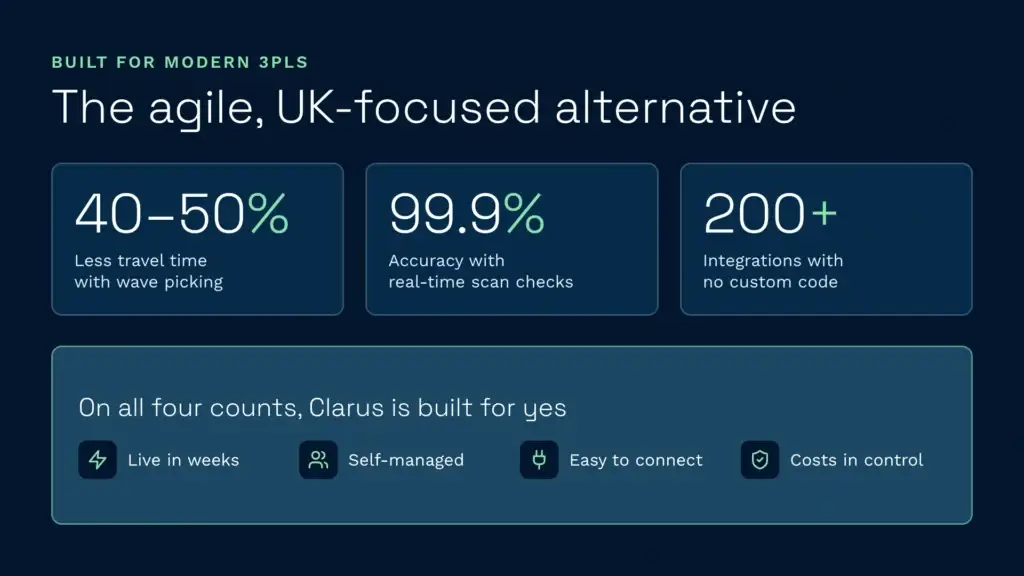
What the features do: Clarus says its smart wave picking can cut travel time by up to 50%, and gerichtete Einlagerung keeps stock where pickers need it. Real-time Scan-Überprüfung blocks mis-scans as they happen, and is designed to hold accuracy at 99.9%. Our guide on reducing picking errors explains how. Integrations span 200+ systems, including major carriers, ecommerce platforms such as Shopify, and ERPs such as Brightpearl, so you can connect your supply chain without custom code. The KI-Assistent adds automated tasks on top, such as catching missed pallet charges and quarantining expired stock.
For a UK 3PL, that’s a different proposition from Infios. You’re not evaluating enterprise automation. You’re asking: can I deploy this quickly, manage it myself, integrate with my customers’ systems and control my costs? Those are the questions Clarus is built to answer yes to.
Sprechen Sie mit einem Lagerfachmann
If you’re weighing up your options and want to see how a purpose-built WMS works in practice, Clarus is worth a conversation. We work with 3PLs and distributors across the UK to implement warehouse management software that fits the way you operate.
Kontaktieren Sie unser Team um Ihre Anforderungen zu besprechen.