

Körber WMS (tidligere HighJump; markedsført som Körber One) er et svært fleksibelt lagerstyringssystem i bedriftsklassen, utviklet for store distribusjonssentre og kompleks automatisering. Men for mellomstore bedrifter 3PL-leverandører og for britiske distributører kan implementeringskostnadene, varigheten av implementeringen og kompleksiteten rundt lisensiering gjøre løsningen uoverkommelig. Denne veiledningen sammenligner Körber WMS med seks skybaserte alternativer som er raskere å implementere og som tilbyr spesialtilpassede 3PL-funksjoner uten de administrative kostnadene som følger med store bedriftsløsninger.
Rask sammenligning: Körber kontra alternativene
| Løsning | Best for | Fakturering for flere kunder | Skynativ | Typisk implementering |
|---|---|---|---|---|
| Clarus WMS | 3PL-leverandører, små og mellomstore distributører, mat og drikke | Innebygd, automatisert | Ja, serverløs | Omtrent 12 uker |
| Körber WMS | Store distribusjonssentre, kompleks automatisering | Ettermontering, kostbart | Lokalt eller privat sky | 9–18 måneder |
| Snapfulfil | E-handel, små og mellomstore 3PL-leverandører | Tilgjengelig, mot ekstra kostnad | Ja, SaaS | 8–12 uker |
| Mintsoft | 3PL-leverandører, e-handel, grossistvirksomhet | Innebygd, standard | Ja, skybasert | 6–10 uker |
| Delta WMS | Bedrift, flere lager | Tilgjengelig | Lokalt eller i skyen | 7 uker |
| Deposco | Shopify, flerkanals e-handel | Tilgjengelig | Ja, SaaS | 2–4 uker |
| Canary7 | Små lager, enkle arbeidsprosesser | Begrenset | Ja, skyen | 4–6 uker |
Hva er Körber WMS?
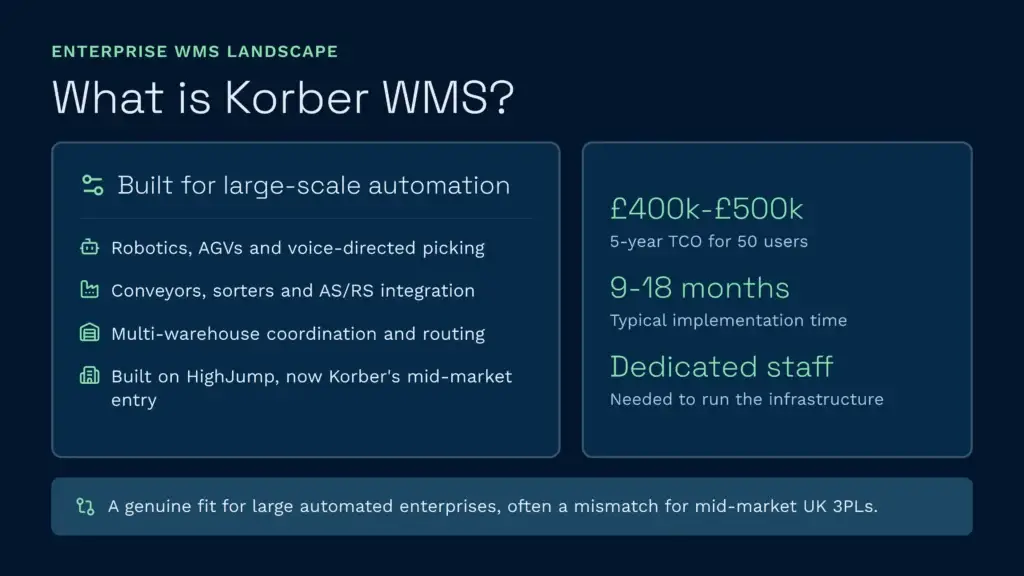
Körber WMS er et lagerstyringssystem for store bedrifter som selges av det tyske logistikkprogramvareselskapet Körber Supply Chain. Den ble utviklet på grunnlag av HighJump-kodebasen: HighJump Warehouse Advantage ble kjøpt opp av Körber i 2015 og markedsføres nå under navnet Körber One, som er Körbers inntreden i mellomstore bedriftsmarkedet.
Systemet er utviklet for å håndtere komplekse operasjoner med høyt volum: store distribusjonssentre med flere automatiseringspartnere (AGV-er, robotteknologi, stemmestyrt plukking), koordinering mellom flere lager og avansert ruteplanleggingslogikk. Körber er ledende når det gjelder integrasjon med fysisk automatisering, inkludert transportbåndsystemer, sorteringsanlegg og automatiserte lagrings- og hentesystemer (AS/RS).
For bedrifter med fysisk automatisering i stor skala er Körber et godt valg. For mellomstore 3PL-aktører og distributører i Storbritannia skaper det imidlertid ofte problemer: de totale eierkostnadene (TCO) for en virksomhet med 50 brukere kan lett komme opp i sekssifrede beløp over fem år, implementeringen tar vanligvis ni til atten måneder, og systemet krever dedikert teknisk personale for å vedlikeholde lokal infrastruktur eller forhandle frem avtaler om privat sky.
Hvorfor lagene ser seg om etter andre alternativer
Tre faktorer fører til at mellomstore bedrifter velger bort Körber WMS.
Implementeringstid
Implementeringer av Körber tar lang tid. Et typisk prosjekt varer mellom 12 og 18 måneder fra kontraktsinngåelse til drift, med omfattende kartleggings- og systemdesignfaser. Organisasjoner som går over til Körber, planlegger vanligvis å bruke seks til ni måneder av interne ressurser bare på datamigrering og kartlegging av arbeidsflyt. Dette medfører forsinket inntekt, økte implementeringskostnader og driftsavbrudd.
Skybaserte 3PL-WMS-plattformer som Clarus er spesielt utviklet for å sikre høy hastighet: konfigurasjon fremfor tilpasning, ferdigutviklede arbeidsflyter for 3PL-fakturering og adskillelse mellom flere kunder, samt skybasert implementering som eliminerer behovet for å sette opp infrastruktur. En typisk implementering tar rundt 12 uker fra kontraktsinngåelse til idriftsettelse.
Kompleksitet ved flere klienter
Körber WMS ble ikke utviklet som et flerklientsystem. Det ble ettermontert for å støtte 3PL-drift flere år etter lanseringen. Dette viser at det å legge til en ny klient i Körber krever dataoppsett, tilpassede rapporter og ofte utviklingstid. Automatisering av fakturering, registrering og fakturering av lagring, plukking, pakking og returer krever manuell konfigurering for hver enkelt klient.
Clarus er spesialutviklet for 3PL-leverandører. Alle kunder som registreres hos dere bruker det samme systemet, men har fullstendig adskilte lagerbeholdninger, faktureringsregler, SLA-er og tilgang til kundeportalen. St John’s Hall Storage reduserte faktureringstiden fra fire timer til tjue minutter ved hjelp av Clarus’ automatiserte faktureringsmotor, som registrerer alle fakturerbare hendelser i sanntid. Körber trenger manuell avstemming eller tilpasset mellomvare for å oppnå det samme.
Clarus WMS: det spesialutviklede 3PL-alternativet
Clarus WMS er et skybasert lagerstyringssystem som er spesialutviklet for 3PL-leverandører, grossister og virksomheter innen mat- og drikkevarebransjen. Systemet kjører på en serverløs skyinfrastruktur: ingen servere å vedlikeholde, ingen versjonsoppgraderinger å planlegge, og alltid den nyeste versjonen.
Hva Clarus gjør bedre enn Körber
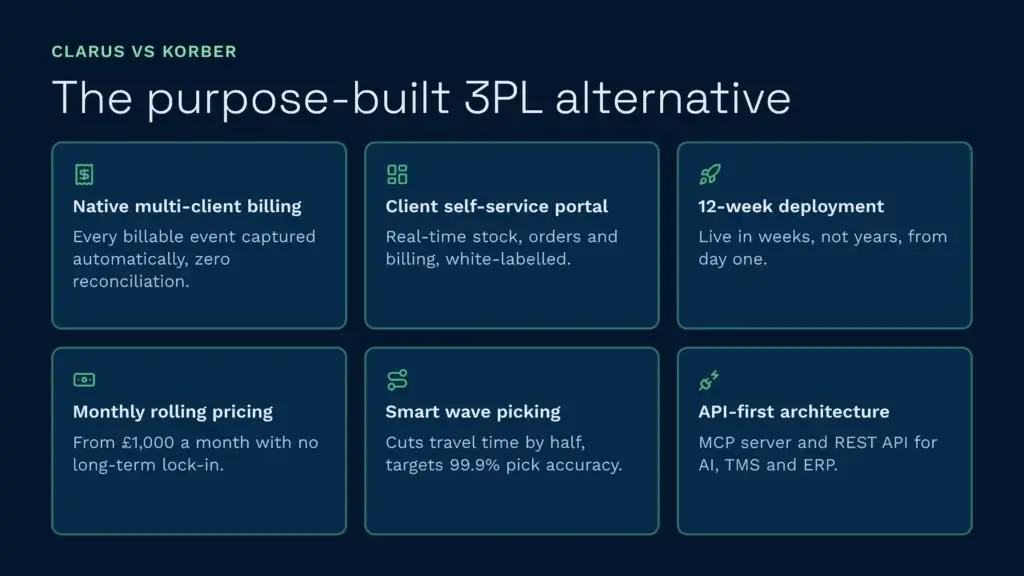
- Innebygd fakturering for flere kunder: alle fakturerbare hendelser (mottak, lagring, plukking, pakking, utsendelse, returer, tilleggstjenester) registreres automatisk. JODA Frakt Dette økte nøyaktigheten i lagerbeholdningen fra lavt 90-tall til 99,81 TP3T og fjernet forsinkelser i lageropptellingen fullstendig. Du fakturerer per kunde, per aktivitet og per periode, med fullstendige revisjonsspor og uten behov for manuell avstemming.
- Selvbetjeningsportal for kunder: Kundene logger seg inn og får oversikt over lagernivåer i sanntid, ordrestatus, sporingsinformasjon og fakturaoversikter. Da slipper du å svare på henvendelser av typen “Hvor er varene mine?”. Portalen kan tilpasses med din egen merkevareprofil.
- Implementeringstid på rundt 12 uker: En standardimplementering måles i uker, ikke år. Du begynner å samle inn sanntidsdata, automatisere fakturering og optimalisere plukking allerede fra oppstarten.
- Månedlig, fleksibel prissetting: fra 1 000 £ per måned uten bindingsperiode. Legg til brukere, legg til nettsteder og utvid virksomheten uten risiko knyttet til langsiktige kontrakter.
- Smart Wave Picking: Grupperer ordrene automatisk og optimaliserer gangveiene, noe som gir en reduksjon i reisetiden på 50%. Verifisering ved skanning i sanntid, der strekkoden må stemme overens med ordren – ellers stopper systemet pakkeren – sikrer en plukknøyaktighet på 99,9%.
- Spesialutviklet for din bransje: mat og drikke? Clarus håndterer FEFO/FIFO-rotasjon, kontroll av holdbarhetsdato og arbeidsflyter for tilbakekalling på få minutter. Campeys of Selby oppnådde tilbakekallinger på under 5 minutter og en AA-karakter i BRCGS-sertifiseringen. Produksjon? Sporbarhet av komponenter, registrering av serienummer og karantenehåndtering er innebygd. E-handel 3PL? Over 70 integrasjoner med transportører, samt Shopify, WooCommerce, Amazon og eBay – klart til bruk.
- API-first-arkitektur: Clarus stiller en MCP-server og REST-API, slik at AI-verktøy, TMS-systemet, ERP-systemet og tilpassede skript kan hente inn og oppdatere lagerdata i sanntid.
Begrensninger ved Clarus
Clarus passer ikke for:
- Rene B2C-distribusjonssentre som kun håndterer pakker (færre enn 10 brukere, høyt volum, lav kompleksitet): vurder i stedet Deposco eller Snapfulfil.
- Store automatiserte distribusjonssentre med integrering av transportbånd, sorteringsanlegg og AS/RS: Körber, Blue Yonder, eller Manhattan Associates er fortsatt bedre alternativer for den størrelsesorden.
- Eldre virksomheter med ett enkelt lager som planlegger å fortsette med lokal drift på ubestemt tid.
Snapfulfil: Med fokus på e-handel, raskt å ta i bruk
Snapfulfil er et skybasert WMS utviklet av Synergy Logistics, rettet mot små og mellomstore e-handelsbedrifter og 3PL-virksomheter. Systemet tilbyr lagersporing, ordrehåndtering, plukkoptimalisering og returhåndtering i et brukervennlig SaaS-grensesnitt.
Styrker
- Kraftig e-handelsintegrasjon: Shopify, WooCommerce, Magento, BigCommerce og Amazon er innebygd.
- Rask implementering, vanligvis 8 til 12 uker fra kontraktsinngåelse til oppstart.
- Støtte for flere lokasjoner og grunnleggende 3PL-kundefunksjoner (tilgjengelig mot ekstra kostnad).
- God pris for små til mellomstore 3PL-leverandører innen e-handel.
Begrensninger
- Fakturering av flere kunder er en tilleggsfunksjon, ikke en innebygd funksjon, noe som medfører ekstra kostnader og økt kompleksitet.
- Pris per bruker er lite skalerbar for team med mer enn 20–30 medarbeidere.
- Begrenset automatisering og lagerstyringsfunksjonalitet sammenlignet med Körber eller Clarus.
- Ikke bransjespesifikt: Mat-, produksjons- og helsevesenet må finne alternative løsninger.
Mintsoft: fokus på skybaserte 3PL-tjenester
Mintsoft er et britiskbasert skybasert lagerstyringssystem (WMS) som er spesielt utviklet for 3PL-leverandører, e-handel og grossistdistributører. Systemet har innebygd støtte for fakturering til flere kunder, og produktet inkluderer en kundeportal og automatisert fakturering som standard.
Styrker
- Spesialutviklet for 3PL-aktører: Segregering og fakturering for flere kunder er kjernefunksjoner, ikke ettermonterte løsninger.
- Sterk tilstedeværelse i Storbritannia og Irland med lokal støtte.
- Trinnvis prissetting med forutsigbar skalering.
- Gode integrasjoner med e-handelsplattformer og transportører (over 70 transportører).
- Kundeportalen er inkludert i alle abonnementer.
Begrensninger
- Et litt mindre moderne brukergrensesnitt sammenlignet med nyere, skybaserte aktører.
- Lagerinformasjon og AI-funksjoner er mer begrenset enn i Clarus.
- Gjennomføringstiden varierer; de oppgitte tidsrammene er ofte kortere enn det datamigreringen i praksis krever.
Delta WMS: modulbasert løsning for bedrifter
Delta WMS (Access Delta WMS) er et modulbasert, skalerbart lagerstyringssystem (WMS) for store og mellomstore lagre, utviklet av Access Group. Det kan implementeres lokalt eller i skyen, og støtter 3PL-drift med aktivitetsbasert fakturering.
Styrker
- Modulær arkitektur: Begynn med kjernefunksjonaliteten og legg til avanserte funksjoner etter behov.
- Lageroppfølging i sanntid og arbeidsflyter for cross-docking.
- Støtte for flere lokasjoner og 3PL-anlegg.
- Fleksibel distribusjon, enten lokalt eller i skyen.
- Relativt rask implementering, med rapporterte oppstartstider på så lite som syv uker.
Begrensninger
- Lisensiering på bedriftsnivå som gjør at den gjerne havner over Körber når det gjelder budsjetter i mellomstørrelsesmarkedet, ikke under.
- Fakturering av 3PL krever konfigurering og er ikke like automatisert som egne 3PL-systemer.
- Distribusjon i skyen kan fortsatt medføre løpende infrastrukturkostnader.
- Det er ikke offentliggjort noen gjennomsiktige månedlige priser.
Deposco: rask ordrebehandling innen e-handel
Deposco er et skybasert WMS som er optimalisert for Shopify, flerkanals e-handel og pakkehåndtering i store volumer. Implementeringen går raskt, vanligvis to til fire uker fra registrering til oppstart.
Styrker
- Rask avkastning: uker, ikke måneder.
- Omfattende integrasjon med Shopify og flerkanals e-handel.
- Aktivitetsbasert prissetting: du betaler for det du plukker, pakker eller sender.
- Et oversiktlig brukergrensesnitt og en mobilapp.
Begrensninger
- Utviklet utelukkende for e-handel; egner seg ikke for generell 3PL-virksomhet eller industriell distribusjon.
- Ingen tradisjonell faktureringsmodul for flere kunder eller 3PL.
- Begrenset lagerinformasjon sammenlignet med Clarus eller Körber.
- Egnet for operasjoner med høyt volum og lav kompleksitet (over 500 plukkinger per dag).
Canary7: et rimelig skybasert WMS for små team
Canary7 er et lettvektig, skybasert lagerstyringssystem (WMS) for små lager og enkle driftsoppgaver. Det tilbyr grunnleggende styring av lagerbeholdning, ordrer og plukking til en pris på inngangsnivå.
Styrker
- Relativt rimelig for små team.
- Rask oppstart, vanligvis fire til seks uker.
- Egnet for enkle operasjoner med én klient (færre enn 5 brukere).
- Grunnleggende integrasjon av mobilapp og API.
Begrensninger
- Ingen innebygd fakturering for flere kunder, og er derfor ikke egnet for 3PL-leverandører.
- Begrenset rapportering og lagerinformasjon.
- Et svært begrenset integrasjonsmiljø, uten ferdige tilkoblinger til operatører eller e-handelsplattformer.
- Ikke egnet for skalering; blir raskt for lite når antallet brukere overstiger 5 til 10.
Funksjon for funksjon: Clarus vs. Körber
| Funksjon | Clarus WMS | Körber WMS |
|---|---|---|
| Segregering mellom flere kunder | Innebygd fra første dag. Hver kunde er isolert med hensyn til lager, fakturering, rapportering og portaltilgang. | Mulighet for ettermontering. Krever tilpasset konfigurasjon og ofte utviklingsarbeid. Dataintegrasjon er kostbart. |
| Automatisert fakturering av tredjepartslogistikk | Native. Registrerer hendelser knyttet til mottak, lagring, plukking, pakking, utsendelse og returer automatisk for hver kunde. St John’s Hall: Faktureringstiden er redusert fra 4 timer til 20 minutter. | Manuell konfigurering for hver enkelt kunde. Krever avstemming og tilpasset rapportering. Utsatt for tap. |
| Skybasert arkitektur | Serverløst – ingen infrastruktur å vedlikeholde. Alltid den nyeste versjonen. | Lokalt eller i privat sky. Krever IT-drift. Versjonsoppgraderinger er nødvendige. |
| Implementeringshastighet | Omtrent 12 uker, konfigurasjonsbaserte, ferdig utviklede 3PL-arbeidsflyter. | 9–18 måneder, med stor vekt på utforskning og design; vanligvis skreddersydd utvikling. |
| Prisgjennomsiktighet | Fra 1 000 £ per måned, månedlig fornyelse, ingen bindingsperiode. Fast funksjonssett per nivå. | Skreddersydd lisensiering for bedrifter. Ingen offentliggjorte priser. Langsiktige kontrakter er vanlig. |
| Plukkingsnøyaktighet | Smart Wave Picking med en nøyaktighet på 99,91 TP3T gjennom skanningsverifisering. Angitt reduksjon i kjøretid på 501 TP3T. | Utmerket for automatisering av store volumer; mindre egnet for manuell plukking. |
| Mat og drikke | FEFO/FIFO-rotasjon, kontroll av holdbarhetsdato, sporing av batcher/partier, tilbakekalling på under 5 minutter, BRC-klar. | Fungerer, men krever tilpasset konfigurasjon. Koster ekstra. |
| Integrasjoner | Over 200 løsninger som er klare til bruk: Shopify, WooCommerce, Amazon, eBay, over 70 transportører, Sage 200, Dynamics, QuickBooks, TMS, pallnettverk. | Omfattende muligheter for integrasjon i bedriftsmiljøer, men det kreves tilpassede koblinger for de fleste. |
| Kundeportal | Selvbetjening inkludert, oversikt over lager, bestillinger og fakturering i sanntid, kan tilpasses med eget merke, uten ekstra kostnader. | Tilgjengelig, men krever vanligvis spesialtilpasset utvikling eller integrasjon med en tredjepartsportal. |
| Svarstid for support | Svarstid på under 2 minutter, ISO 27001-sertifisert. | Bedriftsstøtte tilgjengelig; responstiden varierer avhengig av kontraktsnivå. |
| Best for | 3PL-selskaper (omsetning på 5–500 millioner pund), mat og drikke, grossistdistribusjon, e-handel i mellomstørrelsessegmentet. | Store distribusjonssentre med fysisk automatisering, industriell produksjon og komplekse driftsoperasjoner på tvers av flere anlegg. |
Hvordan velge: Körber WMS eller et alternativ?
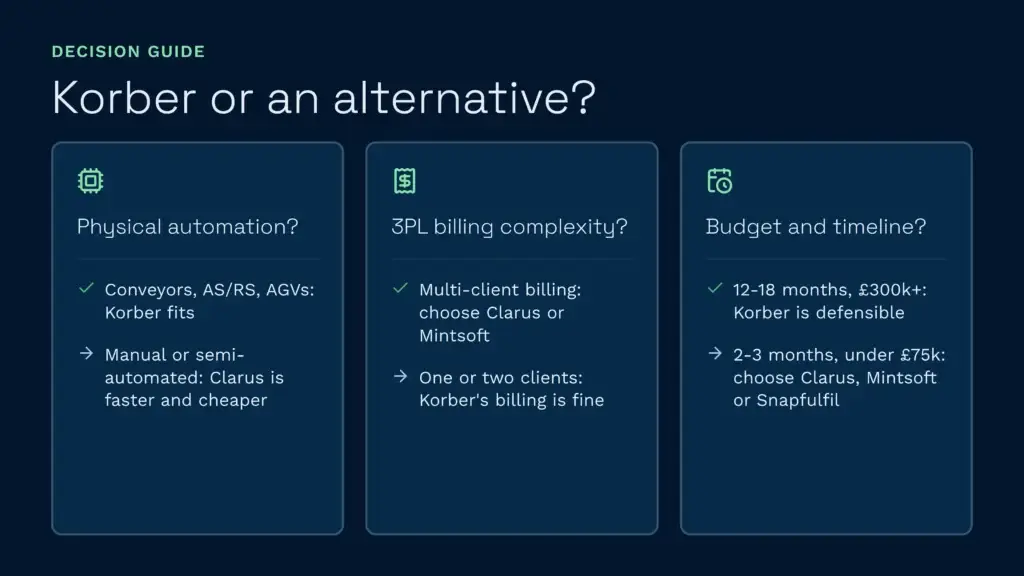
Still deg selv tre spørsmål:
1. Trenger du integrasjon med fysisk automatisering?
Hvis lageret ditt bruker transportbånd, sorteringsanlegg, AS/RS eller AGV-er, og du planlegger å optimalisere materialflyten gjennom avansert automatiseringslogikk, er Körber et bedre valg enn noe annet skybasert lagerstyringssystem (WMS). Dets største styrke ligger i å koordinere fysiske systemer. Clarus og konkurrentene er utviklet for manuell og halvautomatisk drift.
Hvis du bruker gaffeltrucker, skannere og reoler, eller hvis du vurderer å innføre automatisering om to til tre år, er et skybasert system som Clarus et bedre valg: det er raskere å ta i bruk, billigere å skalere og enklere å tilpasse etter hvert som virksomheten din vokser.
2. Hvor komplisert er faktureringen knyttet til 3PL-tjenestene deres?
Hvis du fakturerer flere kunder for lagring, plukking, pakking og tilleggstjenester, og du ikke kan tillate deg noen faktureringsfeil, bør du velge et system som er utviklet spesielt for 3PL: Clarus eller Mintsoft. Det er mulig å tilpasse Körber slik at det kan håndtere 3PL-fakturering, men dette er kostbart og feilutsatt.
Hvis du har én eller to hovedkunder og faktureringen er enkel (en fast månedlig avgift), er Körbers generelle faktureringsmodul helt greit.
3. Hva er budsjettet og tidsplanen for implementeringen?
Hvis du har 12 til 18 måneder på deg og et budsjett på bedriftsnivå for implementering og lisensiering, er Körber et forsvarlig valg for store, komplekse virksomheter.
Hvis du må gå live innen tre måneder og har et stramt budsjett, bør du velge Deposco eller Canary7.
Hvis du har to til tre måneder på deg og et moderat implementeringsbudsjett, bør du velge Clarus, Mintsoft eller Snapfulfil.
Overgang fra Körber til et skybasert WMS
Hvis du allerede bruker Körber og vurderer å bytte, er migrering mulig, men krever planlegging.
- Dataeksport: Körber eksporterer til CSV-filer eller flatfiler. Aktuell lagerbeholdning, stamdata, åpne ordrer og kundedata kan hentes ut og omformateres for det nye systemet ditt.
- Overgangsstrategi: Planlegg enten en fullstendig overgang (i løpet av en helg eller over natten) eller en trinnvis overgang (migrer én produktlinje om gangen). Både Clarus og Mintsoft støtter trinnvis overgang.
- Tidsplan: to til fire uker med forberedelser, én til to uker med selve dataoverføringen og testing, samt én uke med støtte ved igangsetting.
- Omskolering av personale: Clarus og andre skybaserte systemer er betydelig enklere enn Körber, så teamet ditt vil vanligvis trenge én til to ukers opplæring, ikke seks til åtte.
- Integrasjoner: ERP-, TMS- og e-handelsforbindelsene må tilpasses på nytt til det nye systemets API-er. Dette er vanligvis den mest tidkrevende delen av migreringen, og tar som regel to til fire uker.
Snakk med en lageransvarlig
Hvis du vurderer ulike alternativer og ønsker å se hvordan et spesialutviklet lagerstyringssystem (WMS) fungerer i praksis, er Clarus verdt å ta en prat med. Vi samarbeider med 3PL-leverandører og distributører over hele Storbritannia for å implementere lagerstyringsprogramvare som tilpasses din driftsmodell – ikke omvendt.
Ta kontakt med teamet vårt å snakke gjennom dine krav.