

Wenn Sie bewerten Die SCExpert-Plattform von Made4net and wondering whether there’s a better fit for your warehouse operations, you’re not alone. Made4net is a capable enterprise WMS with strong yard management and labour planning, but it’s not the only choice. For many 3PLs, wholesale distributors and food operations, alternatives offer faster implementation, simpler pricing and a tighter focus on 3PL work. This guide compares Made4net with six alternatives, including where each excels and where it falls short.
The best WMS for your operation depends on what you actually need to solve. Are you struggling with multi-client billing and stock segregation? Need real-time visibility across sites? Spending too long on month-end invoicing? A system built for 3PL work will usually cost less and go live faster than an enterprise platform configured to do the same job. Let’s walk through your options.
Schnellvergleich: Made4net im Vergleich zu Alternativen
| WMS-Lösung | Am besten für | 3PL-Abrechnung | Multi-Client | Bereitstellung | Umsetzungszeit |
|---|---|---|---|---|---|
| Clarus WMS | 3PL, wholesale, food & beverage | Automatisierte Erfassung von Ereignissen in Echtzeit | Pro Kunde vollständig isoliert | Nur in der Cloud | Etwa 12 Wochen (Standard) |
| Made4net (WarehouseExpert) | Unternehmensweite, standortübergreifende Betriebsabläufe | Individuelle Konfiguration erforderlich | Unterstützt, manuelle Einrichtung | Cloud oder vor Ort | Nicht veröffentlicht |
| Snapfulfil | E-Commerce, Kommissionierung großer Mengen | Nicht veröffentlicht | Grundlegende Unterstützung | Cloud oder vor Ort | Nicht veröffentlicht |
| Mintsoft | 3PL, Multi-Client-Distribution | Automatische Ereigniserfassung | Umfassende Unterstützung für mehrere Mandanten | Nur in der Cloud | Nicht veröffentlicht |
| Körber | Unternehmen, stark automatisierte Standorte | Fortgeschritten, modulabhängig | Umfassende Unterstützung | Vor Ort, Cloud | Nicht veröffentlicht |
| Helm (ehemals Despatch Cloud) | E-Commerce, Wachstumsphase bei 3PL | Grundlegende Mehrbenutzer- und Stapelverarbeitung | Grundlegende Unterstützung | Nur in der Cloud | Nicht veröffentlicht |
| Deposco | E-Commerce, Größe des Fulfillment-Centers | Nicht veröffentlicht | Begrenzt | Nur in der Cloud | Nicht veröffentlicht |
Clarus WMS: the best Made4net alternative for 3PLs
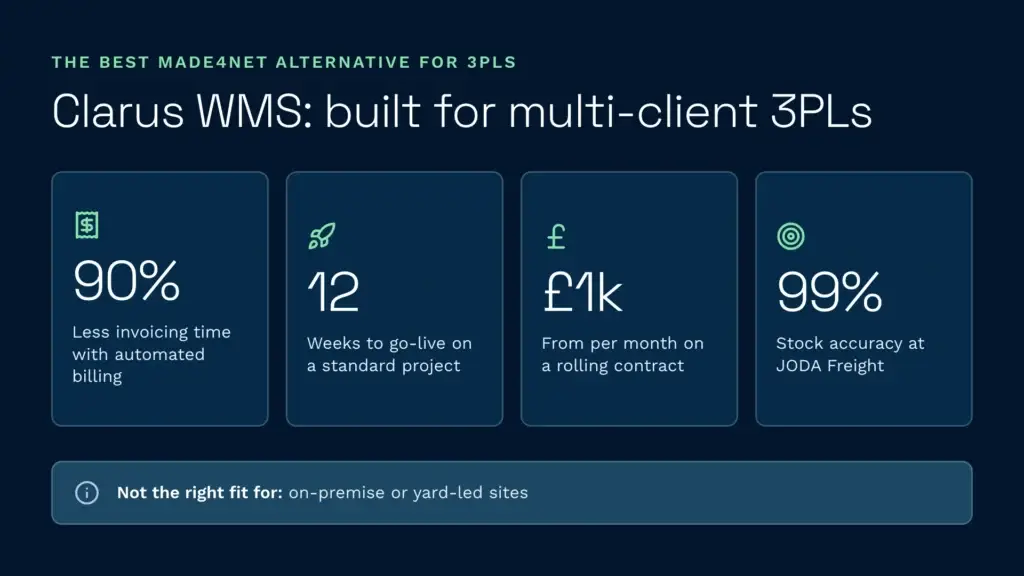
Clarus is a cloud WMS designed specifically for warehouses that manage multiple clients from a single facility. If your operation’s real problem is 3PL billing and multi-client complexity, Clarus handles both from end to end.
Wo Clarus punktet
Automatisierte 3PL-Abrechnung, die wirklich funktioniert. The system captures billable activity automatically as it happens: putaway, storage, picking, packing, returns, cycle counts and any value-added service you define. There’s no re-keying at month-end, no reconciliation spreadsheets and no arguing with clients about what was actually done. St John's Hall Lagerung, a UK third-party warehousing provider, cut its invoicing time by 90% after switching to Clarus. Its managing director had been spending around four days at the end of each month checking invoices built from re-keyed data. Once the data proved reliable, the checks stopped and invoicing moved from monthly to weekly.
Multi-client stock segregation that’s properly separate. Each client’s inventory, reporting and SLAs live in isolation within the same warehouse, and each client gets its own branded portal showing only the data they’re authorised to see. When you add a new client or change their pricing rules, you don’t reconfigure the whole system.
Umsetzungsgeschwindigkeit, auf die es ankommt. A standard Clarus implementation goes live in around 12 weeks. That’s not a marketing claim. It comes from Mathew Buttar, who leads Clarus implementations and go-lives, speaking from nearly 25 years in warehouse operations: “a standard project with the correct support on both sides, we’d aim to get live within 12 weeks, and 12 weeks is a good standard because you need to allow people time.” Complex multi-feature projects take longer.
Pricing you can see. Clarus pricing starts from £1,000 per month on monthly rolling contracts, with unlimited orders and shipments. Your quote adds tiered user licensing and a one-off implementation fee, so you know the full picture up front. Made4net doesn’t publish pricing.
KI, die auch auf der kommerziellen Ebene zum Einsatz kommt. Clarus’s KI-Lagerassistent doesn’t just direct work on the warehouse floor. It also catches missed pallet charges across customer accounts, processes batch orders and runs invoice cycles. For a 3PL, that’s the layer that pays the bills, because margin leaks through charges that never make it onto an invoice.
Where Clarus isn’t the right fit
Clarus is cloud-only, with no on-premise option. If your organisation requires servers on site for regulatory or data residency reasons, you need to look elsewhere.
Clarus doesn’t have a dedicated yard management module or a returns module. If your operation is dominated by dock scheduling and yard logistics, Made4net’s integrated yard management or a platform like Körber might be the better fit. Similarly, Clarus doesn’t include temperature mapping or heatmap visualisation for frozen and chilled environments. If you need that as part of your WMS, ask during discovery, because it’s a real gap on the Clarus side.
Clarus is purpose-built for 3PL and distribution. If your operation is pure B2C ecommerce at parcel-only scale, you may find a lighter tool like Helm is enough.
Echter Beweis
JODA Fracht, which stocks and distributes refrigeration units for retail, reached 99% stock accuracy by year two. Stock takes went from weeks on Excel to one day, with year-end counts completed in two to three days. MSD (Mitchell Storage & Distribution) cut its warehouse admin by 60%, with customer emails and calls asking about stock levels down by about 60%, and now bills for services such as cross docking, kitting and re-boxing that used to go unrecorded. These are outcomes from published customer stories, not estimates.
Made4net (WarehouseExpert): the enterprise WMS with depth
Made4net’s WarehouseExpert is the WMS module of the SCExpert supply chain execution platform. It’s mature and well established, and Made4net’s warehouse page says it has been named in the Gartner Magic Quadrant for Warehouse Management Systems for 11 years in a row. Made4net sells into consumer goods, ecommerce, food and beverage, manufacturing, retail, 3PL and wholesale distribution.
Wo Made4net sich auszeichnet
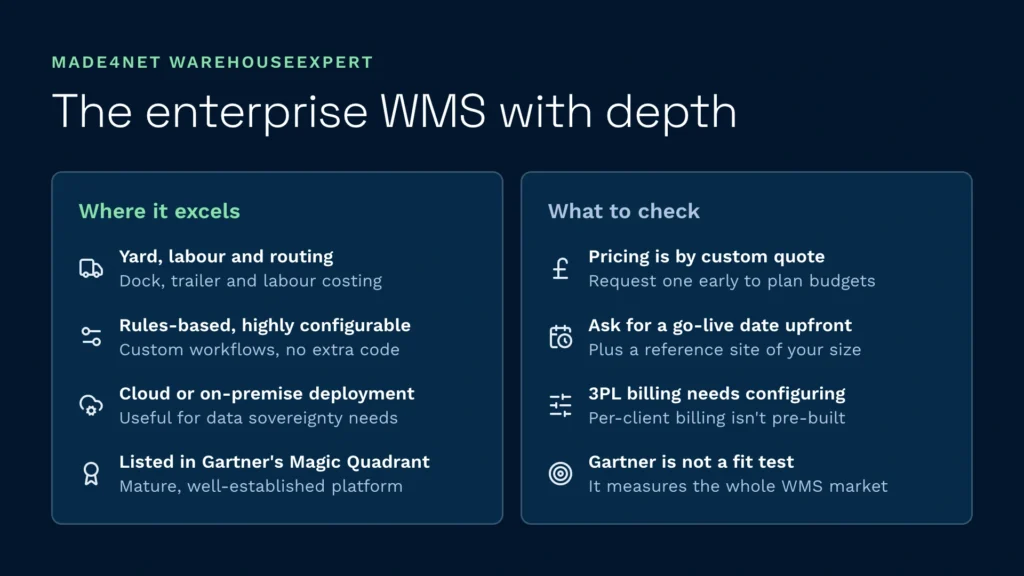
Integriertes Lagermanagement und Personalplanung. Made4net’s platform combines warehouse management, yard management, labour management, route optimisation and last-mile delivery in one place. If your operation has complex dock scheduling, outbound trailer coordination and detailed labour costing, that integration is valuable.
Regelbasierte Konfigurierbarkeit. The system is built on Microsoft technology and described as a flexible, rules-based platform with configurable workflows, screens and dashboards. Users can build screens, views and reports without coding.
Umfangreiche Funktionen. The platform supports cartonisation, task interleaving, optimised scheduling, labour management and cycle counting. It’s built to handle high-volume, complex operations.
3PL capability. Made4net’s 3PL page describes a built-in billing engine for 3PL operations that tracks activity by client, and multi-client, multi-warehouse management within a single instance.
Flexibilität bei der Bereitstellung. Sie können Made4net in der Cloud oder auf Ihren eigenen Servern betreiben, was von Bedeutung ist, wenn Datenhoheit eine zwingende Voraussetzung ist.
In welchen Fällen erfordert Made4net eine sorgfältige Bewertung?
Pricing isn’t transparent. Made4net doesn’t publish pricing on its platform page or WarehouseExpert page. Prospective customers must request a quote, which makes early budget planning harder, particularly for mid-market operators without a procurement team. Compare that to Clarus’s published pricing.
Implementation timescales aren’t published. Made4net doesn’t state a standard go-live time on its platform or WarehouseExpert pages, and we won’t put a number on it for them. What their pages do describe is a broad, highly configurable platform spanning warehouse, yard, labour and routing, with dynamic workflows and MHE integration. Breadth and configurability of that kind take time to design and test, so ask them directly for a go-live date and a reference customer of your size. The longer any implementation runs, the longer you operate without the benefit.
Test the 3PL billing on your own rules. Made4net lists 3PL billing as a feature, so the question isn’t whether it exists but how it handles your contracts. Ask them to run a month-end invoice for two of your real clients, with your real rate cards, before you shortlist.
Gartner’s Magic Quadrant doesn’t tell you fit. Made4net’s Magic Quadrant listing is good industry validation. But the Magic Quadrant measures execution and vision across the whole WMS market, not fit for your specific vertical. A 3PL and an automotive manufacturer have very different needs, and Gartner’s position doesn’t distinguish between them.
Snapfulfil: cloud WMS for high-volume fulfilment
Snapfulfil is a cloud-based WMS from Synergy Logistics, aimed at mid-market ecommerce retailers and fulfilment operations. It includes 3PL features such as multiple billing options, pro-forma invoicing and a client portal.
Am besten geeignet für: Ecommerce fulfilment centres, parcel-heavy operations, high-velocity picking.
In welchen Punkten es gegenüber Clarus den Kürzeren zieht: Snapfulfil handles multiple clients by treating each one as a separate warehouse within the same system. If you’re a 3PL with 10 clients on different billing rules and reporting needs, ask to see exactly how that set-up maps to your contracts. Our Snapfulfil alternative guide goes into more detail.
Preise: Nicht veröffentlicht. Auf Zitaten basierend.
Mintsoft: the 3PL specialist
Mintsoft is cloud-only and built for 3PLs and distribution. Its multi-client support is strong, and client billing is included in its core 3PL plan. In many ways, Mintsoft and Clarus compete directly in the 3PL space.
Am besten geeignet für: 3PL-Anbieter, Mehrkundenlager, Distributionszentren.
Wo Clarus punktet: Speed of implementation and pricing structure. Clarus targets around 12 weeks for a standard project. Mintsoft doesn’t publish a standard implementation time, so ask them for one. Mintsoft’s 3PL pricing is tiered by monthly order volume and number of clients, with white labelling as an optional add-on, so costs step up as you grow. Clarus doesn’t bill on throughput. Clarus’s AI also reaches the commercial layer: missed charges, batch orders and invoice cycles. See our Mintsoft alternative guide for more.
Wo Mintsoft punktet: Market presence and an established integration library. Each core plan includes 131 standard integrations, so if you need a specific carrier, channel or tool that’s already part of the Mintsoft ecosystem, you may find it already built.
Preise: Starting prices for standard tiers are published. Enterprise volumes are priced on application.
Körber (now Infios): the enterprise automation play
Körber’s supply chain software business, a joint venture between Körber AG and KKR, rebranded as Infios in March 2025. It’s built for large, automation-heavy operations. If your site runs automated storage and retrieval systems, conveyor networks or robotic picking, that’s where it earns its place.
Am besten geeignet für: Großunternehmen, stark automatisierte Distributionszentren, integrierte Flurförderzeug-Ökosysteme.
Where it’s overkill: Körber doesn’t publish implementation timescales or pricing, and enterprise automation projects are scoped per site, so insist on both in writing before you shortlist them. If you’re a mid-market 3PL or distributor without significant automation, you’re paying for capability you won’t use. We cover the trade-offs on our Körber WMS alternative page.
Preise: Nur für den Unternehmensgebrauch, nicht zur Veröffentlichung bestimmt.
Helm (formerly Despatch Cloud): the fast ecommerce start
Helm is the new name for Despatch Cloud’s WMS. It describes itself as a multi-channel OMS and WMS designed for ecommerce, serving 3PLs and ecommerce brands.
Am besten geeignet für: Fast-growing ecommerce 3PLs, shops looking to add fulfilment, businesses that need to go live quickly.
Was Clarus auszeichnet: Billing depth. Helm’s site doesn’t describe multi-client billing, so ask how it would invoice your clients. Clarus captures billable activity (putaway, storage, pick, pack, returns, value-added services) automatically, which matters for a 3PL trying to improve margin visibility.
Preise: Nicht veröffentlicht. Auf Zitaten basierend.
Deposco: modern cloud, ecommerce focus
Deposco is a cloud WMS and OMS platform focused on ecommerce fulfilment. It also sells to 3PLs, and its 3PL fulfilment page lists 3PL billing automation and fast client onboarding.
Am besten geeignet für: Ecommerce operations and fulfilment centres that need WMS and order management on one platform.
What to check: If you’re a multi-client 3PL, ask Deposco to show billing and reporting for two of your actual clients side by side, the same test we’d suggest for any vendor on this list.
Preise: Nicht veröffentlicht. Auf Zitaten basierend.
Welches ist das beste Lagerverwaltungssystem?
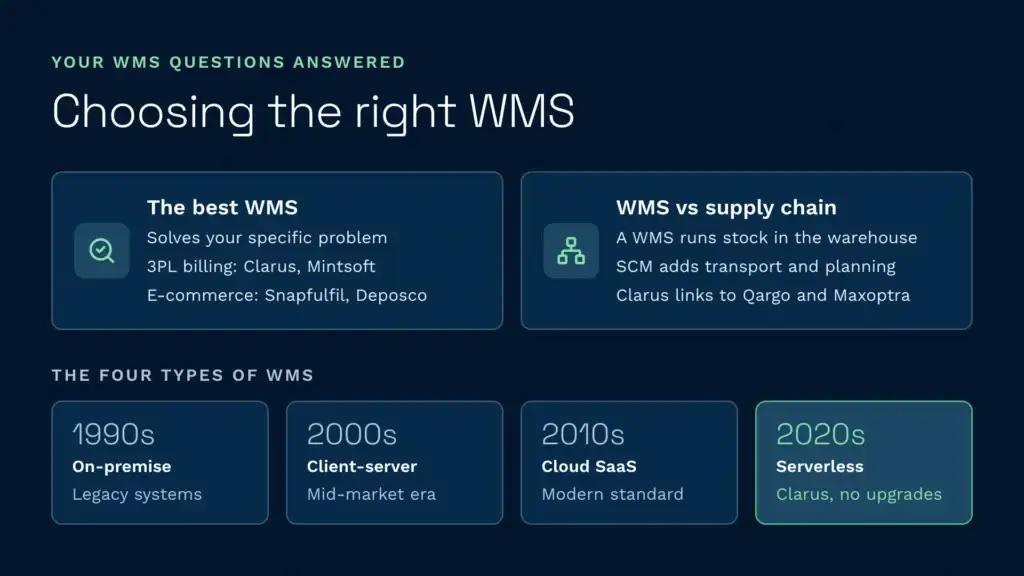
The best WMS is the one that solves your specific operational pain. If you’re losing margin on missed charges and struggling to bill accurately, the best system is one that captures billable events automatically. Clarus and Mintsoft are built around this, and Made4net, Snapfulfil and Deposco all list 3PL billing too, so test each against your own rate cards. If you’re drowning in multi-client complexity and month-end reconciliation, look for a system built for multi-client work from the start. If you run high-velocity ecommerce picking, Snapfulfil or Deposco may be your best choice. If you have integrated automation, Körber is a strong fit. Our WMS buyer’s guide covers the wider field.
Welche Software eignet sich am besten für das Lieferkettenmanagement?
Warehouse management and supply chain management are related but different. A WMS controls the movement of stock inside a warehouse. A supply chain platform combines WMS with transportation management (TMS), inventory planning, demand forecasting and supplier management. Made4net’s SCExpert includes yard management and last-mile delivery, so it approaches supply chain management as an integrated platform. Clarus is WMS-focused, but it connects to TMS tools like Qargo und MaxOptra, so you get visibility across warehouse and transport without paying for features you don’t use.
Welche vier Arten von WMS gibt es?
The four types are usually described as a standalone WMS, a WMS module within supply chain management software, a WMS module within an ERP system, and a cloud-based WMS. Clarus is a cloud-based standalone WMS that connects to other systems through ready-made connectors or its API. Made4net sits within its own supply chain execution platform and supports both cloud and on-premise deployment, which gives you flexibility but also means managing servers, patches and updates yourself if you go on-premise. Snapfulfil, Mintsoft, Helm and Deposco are all cloud systems.
Was ist eine digitale Lieferkettenplattform?
A digital supply chain platform is software that connects procurement, warehouse, transport and last-mile delivery into a single data stream, so every stakeholder (supplier, warehouse, carrier, customer) sees real-time status and can act on it. Made4net’s SCExpert aims to be that, combining yard, WMS, labour and routing in one place. Clarus is WMS-focused but gains supply chain visibility through Integrationen with accounting systems such as Sage and Xero, TMS tools and carrier APIs. What matters isn’t whether the platform is “unified” (all modules in one codebase) but whether the connections work without manual handoff.
How to choose between Made4net and its alternatives
Beginnen Sie mit Ihrem größten betrieblichen Problem. Is month-end invoicing taking a week and creating disputes? That’s a 3PL billing problem, and Clarus or Mintsoft are built for it. Is it yard congestion and dock inefficiency? That’s a yard management problem, and Made4net has that integrated. Is it picking speed at high volume? That’s a parcel-fulfilment problem, and Snapfulfil, Helm or Deposco are worth a look. Don’t buy a feature you don’t need. That’s how projects get expensive.
Erstellen Sie einen realistischen Zeitplan für die Umsetzung. Ask each vendor for a reference customer of your size (not their largest customer) and ask that reference how long they actually took, not what the vendor says. Then build in contingency on top.
Understand what “pricing” means when they won’t quote it. If a vendor doesn’t publish pricing, you can’t benchmark it before you’re in a sales conversation. Clarus’s published pricing from £1,000 per month gives you a figure to compare against, and our WMS cost guide breaks down what else to budget for.
Testen Sie die Multi-Client-Funktion auf einem Interessentenkonto. If you’re a 3PL evaluating any WMS, ask the vendor to set up a sandbox with two of your actual clients, using real billing rules, and show you what a month-end invoice looks like. That two-hour demo will tell you more than a product roadmap.
Vergleichen Sie die Gesamtbetriebskosten und nicht nur die Lizenzkosten. Implementation, training, integration and support over three years is what you’re buying. A system that costs more per month but goes live sooner can be cheaper overall, because you start generating a return earlier. Make each vendor commit to a go-live date and hold the comparison to that.
Sprechen Sie mit einem Lagerfachmann
If you’re evaluating your options and want to see how a purpose-built WMS works in practice, Clarus is worth a conversation. We work with 3PLs and distributors across the UK to implement warehouse management software that fits the way you operate, not the other way around.
Kontaktieren Sie unser Team um Ihre Anforderungen zu besprechen.