

Managing orders at scale is one of the biggest operational challenges facing modern 3PL providers and ecommerce businesses. Whether you’re handling 100 orders a day or 10,000, the complexity multiplies fast: tracking inventory across warehouses, syncing with multiple sales channels, managing customer expectations, and coordinating shipping logistics. This is where ecommerce software de gestión de pedidos becomes essential. A robust system doesn’t just keep orders moving, it transforms how your warehouse operates, reduces picking errors, accelerates shipping times, and ultimately improves profit margins.
In this guide, we’ll explore what ecommerce order management software is, why it matters for 3PLs and ecommerce businesses, and how to choose the right solution for your operation.
What Is Ecommerce Order Management Software?
Ecommerce order management software is a centralised platform that captures, processes, tracks, and fulfils customer orders from multiple sales channels in real time. Rather than juggling spreadsheets, manual data entry, and fragmented systems, order management systems unify the entire order lifecycle in one place.
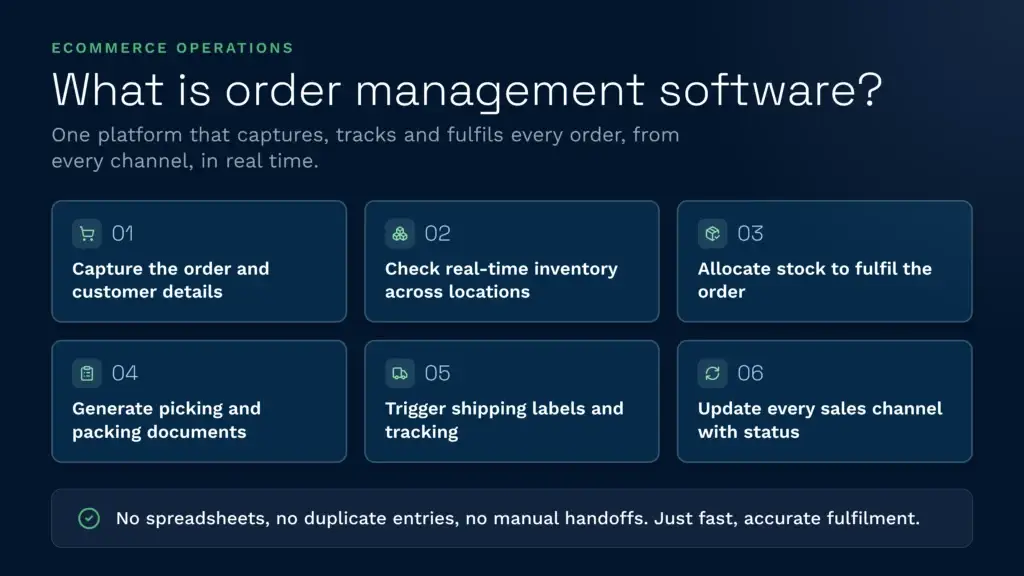
Think of it as the nervous system of your warehouse. When a customer places an order on your Tienda virtual tienda, Amazonas, o eBay, the system immediately:
- Captures the order and customer details
- Checks real-time inventory across multiple locations
- Allocates stock to fulfil the order
- Generates picking and packing documents
- Triggers shipping labels and tracking information
- Updates all sales channels with status changes
This automation eliminates the manual handoffs, duplicate entries, and human error that plague legacy systems. It’s the backbone of fast, accurate order fulfilment.
Why Ecommerce Order Management Systems Matter for 3PLs
For third-party logistics providers, an ecommerce order management system isn’t a luxury, it’s a competitive necessity. Your clients expect same-day or next-day processing, accurate order status updates, and minimal errors. You can’t deliver on those promises with manual processes.
A purpose-built 3PL order management solution delivers several critical advantages:
Rapidez y precisión
Automated order allocation and picking routes reduce fulfilment time from hours to minutes. Escaneo de códigos de barras at every step eliminates recogida errors, which translates to fewer customer complaints and chargebacks.
Integración multicanal
Modern ecommerce order management software syncs with Shopify, WooCommerce, Amazon, eBay, Magento, and dozens of other platforms. Orders land in your system automatically, reducing manual data entry and keeping inventory counts accurate across all channels simultaneously.
Visibilidad del inventario en tiempo real
With centralised inventory management, you see stock levels across all warehouses in real time. This prevents overselling, enables accurate fulfil-ability checks, and lets you identify slow-moving stock before it ties up capital.
Scalability Without Headcount
As order volumes grow, a properly configured order management system scales with you. You can process 5x more orders without proportionally increasing warehouse staff, because the system handles routing, allocation, and communications automatically.
Client Transparency
Clients get real-time order status, shipment tracking, and exception alerts. This reduces inbound support queries and builds trust. Many systems offer branded client portals so your customers feel they’re working with a tech-forward operation.
Key Features of Effective Order Management Systems
Not all order management software is created equal. Here’s what separates the best solutions from basic order ticketing systems:
Asignación de pedidos entre varios almacenes
Smart allocation rules route orders to the nearest warehouse, the location with the most stock, or based on service level requirements. This minimises shipping costs and accelerates delivery times. Some systems use AI to predict demand and pre-position inventory, further optimising allocation.
Inventory and Order Management Integration
The system must keep stock levels in sync across your warehouse, sales channels, and customer portals. When you pick an item, inventory updates instantly. When an item is returned, stock is restored automatically. This eliminates the “ghost inventory” problem where counts don’t match reality.
Automated Workflows
Define conditional rules: if an item is out of stock, automatically offer a backorder date or substitute product. If shipping exceeds five days, automatically send a proactive customer email. If an order contains hazardous goods, flag it for special handling. These automation rules save hours of manual work daily.
Mobile and Barcode Scanning
Warehouse staff need to scan códigos de barras at receipt, storage, and pick stages. Mobile-optimised interfaces let pickers work hands-free, using device cameras for rapid scanning. This dramatically reduces errors and speeds up picking processes.
Shipping Integration
The system should connect directly to carriers (Correos del país, FedEx, Royal Mail, UPS, etc.) to generate labels, book shipments, and track packages in real time. Some solutions offer rate shopping to automatically select the cheapest carrier per shipment.
Returns and Reverse Logistics
A mature order management system handles returns as seamlessly as outbound orders. Customers generate return labels, items are received and inspected, and refunds or replacements are triggered. This reduces the time returned stock sits in limbo.
Informes y análisis
Real-time dashboards show order volumes, fulfilment times, error rates, and carrier performance. Historical reports identify trends, bottlenecks, and improvement opportunities. This data is critical for optimising warehouse operations and demonstrating value to clients.
Inventory and Order Management Software: The Unified Approach
The most effective solutions combine order management with beneficios del sistema de gestión de almacenes into a single platform. Why? Because orders and inventory are inseparable. You can’t accurately fulfil an order without real-time stock visibility. You can’t optimise inventory without understanding demand patterns from your order data.
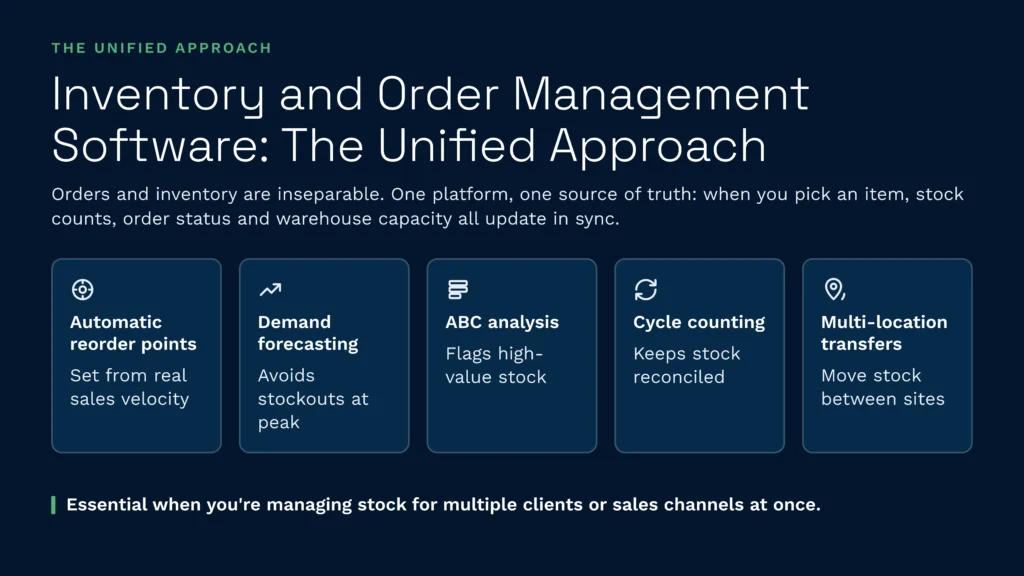
This unified approach, often called an el mejor sistema de gestión de almacenes, eliminates data silos and ensures a single source of truth. When you pick an item, your order status, inventory count, and warehouse capacity all update in sync.
For ecommerce stock management software specifically, this means:
- Automatic reorder point calculations based on sales velocity
- Demand forecasting to prevent stockouts during peak seasons
- ABC analysis to identify high-value inventory requiring closer control
- Cycle counting and inventory reconciliation workflows
- Multi-location stock transfer capabilities
These features are essential if you’re managing inventory for multiple clients or multiple sales channels simultaneously.
Order Management Systems for B2B Ecommerce
B2B order management software has unique requirements compared to B2C systems. B2B orders tend to be larger, involve complex approval workflows, require detailed invoicing, and often include custom payment terms.
An enterprise-grade 3PL systems solution for B2B must support:
- Multi-level approval chains for large orders
- Custom pricing per customer and volume tier
- Blanket order processing with scheduled releases
- Drop-ship and made-to-order workflows
- Detailed reporting for cost allocation and billing
- Integration with ERP systems for SAP, NetSuite, and other enterprise platforms
The complexity is higher, but the payoff is significant. B2B clients are more demanding about precisión and timeliness, so a system that eliminates errors and accelerates processing is a major competitive advantage.
Ecommerce Order Management System vs. Manual Processes: The ROI Case
The upfront investment in an ecommerce order management system can seem significant. Software licenses, implementation time, staff training, data migration. But the return on investment is typically recovered within 6–12 months.
Here’s why:
Labour Savings: Order entry, inventory updates, and shipping label generation are largely automated. A typical warehouse can reduce manual order processing time by 60–70%. If you employ two staff members at full-time equivalent solely on order processing, you’ve recovered your annual software investment immediately.
Error Reduction: Errores en la preparación de pedidos, shipping mistakes, and inventory discrepancies are expensive. A single wrong shipment costs £50–150 in chargeback fees, return shipping, and staff time. Reduce errors by even 5%, and you’re talking thousands of pounds annually in savings.
Faster Cash Conversion: With faster order-to-shipment times, customers are satisfied sooner, returns decrease, and payment disputes diminish. You also recover working capital faster when goods move through the warehouse quicker.
Scalability Without Proportional Cost Increases: If you can process 10,000 orders monthly with existing staff, a well-configured system can often handle 20,000 or more without additional headcount. This is the “hidden” ROI that becomes visible only after months of operation.
Choosing the Right Solution: E-Commerce order management Platforms
When evaluating solutions, consider these critical factors:
Scalability and Architecture
Will the system grow with you? Does it handle high transaction volumes without slowdowns? Is it cloud-based (better for uptime and automatic updates) or on-premises (more control but higher maintenance)? Ask about transaction throughput, concurrent user limits, and disaster recovery capabilities.
Integration Ecosystem
How many sales channels, carriers, and accounting systems does it connect with natively? How difficult and expensive are custom integrations? Platforms like 15 Best Ecommerce Order Management Systems vary significantly in their connectivity. Some offer hundreds of pre-built integrations, while others require custom development.
Ease of Implementation
How long does a typical deployment take? A mission-critical system should ideally go live within 6–12 weeks. If the vendor quotes 6 months, that’s a red flag. Also ask about data migration support and whether they have proven implementation methodologies.
User Interface and Adoption
Is the system intuitive for warehouse staff who may have limited technical backgrounds? Can pickers learn to use mobile scanning in a single shift? Poor user experience leads to workarounds, which eventually defeats the purpose of the system.
Support and Training
What level of support is included? Is there a dedicated account manager? Are training materials included? For warehouse operations, strong support is critical because downtime costs money.
Vendor Stability and Roadmap
Is the vendor profitable and stable? Are they investing in product development, or are they stagnating? A vendor with a clear product roadmap is more likely to support your needs for years to come.
For benchmarking, check Order Management Software – Price Comparison & Reviews y Order Management Software | Sage UK to see how popular solutions compare in functionality and pricing.
Implementation Best Practices
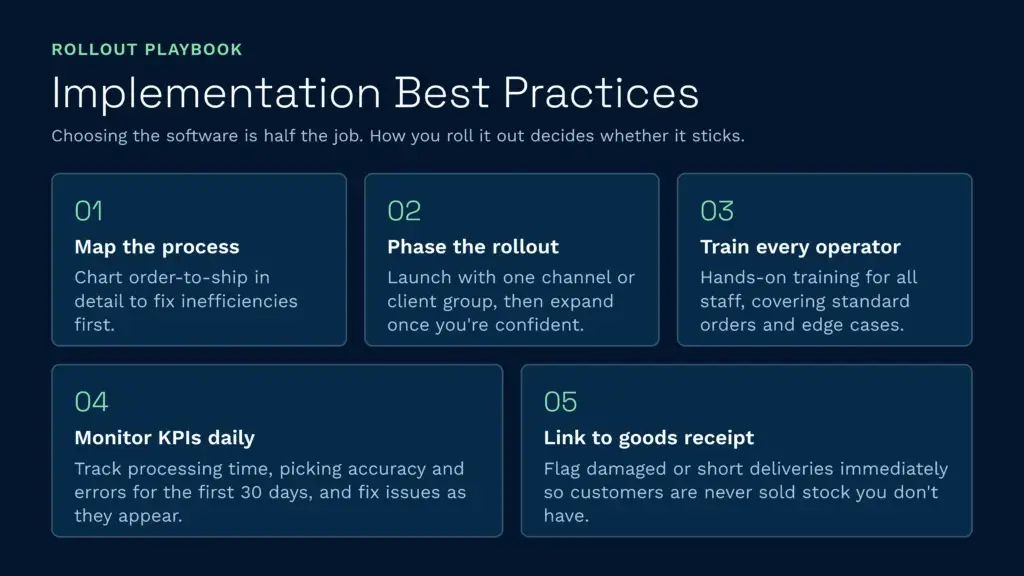
Selecting the right software is half the battle. Implementation is where many projects falter. Here are key practices for a successful rollout:
Start with Process Mapping
Before configuring the system, map your current order-to-ship process in detail. Identify bottlenecks, manual steps, and exceptions. This exercise often reveals inefficiencies that the new system can eliminate outright. Don’t just replicate your old manual process in software.
Phase the Implementation
Go live with a single sales channel or a subset of clients first. Once you’re confident, expand to other channels. A phased approach reduces risk and lets you refine processes with lower stakes.
Train Thoroughly
Provide hands-on training to all warehouse staff, not just supervisors. Staff confidence directly correlates with system adoption. Include training on both the “happy path” (standard order processing) and edge cases (out-of-stock, returns, damaged goods).
Monitor KPIs Daily
During the first 30 days post-launch, monitor key metrics: order processing time, picking accuracy, shipping errors, and system downtime. If you spot issues, address them immediately. Don’t wait for a monthly review meeting to discover that picking accuracy dropped 10%.
Link to goods in process Management
Ensure your order management system is tightly integrated with inbound goods receipt and gastos de almacén tracking. Goods that arrive damaged or with incorrect quantities must be flagged immediately so customers aren’t sold stock that isn’t actually available.
The Future of Order Management: AI and Predictive Analytics
The next generation of order management systems is incorporating artificial intelligence and machine learning to predict demand, optimise allocation, and flag exceptions before they impact customers.
For example, a smart order management system might:
- Predict demand spikes 2–3 weeks in advance so you can pre-position inventory
- Automatically suggest which orders to fulfil from which warehouse to minimise total shipping cost
- Flag orders with high return likelihood (based on customer history and product type) for priority quality checks
- Predict carrier delays and proactively offer customers expedited alternatives
These capabilities are moving from “nice to have” to “expected” in enterprise-grade solutions, particularly for high-volume 3PL operations.
Ready to Transform Your Order Management?
Navigating the complexities of multi-channel integration, real-time inventory, and automated workflows doesn’t have to be a solo endeavour. At Clarus, we specialise in helping Proveedores de servicios logísticos externos (3PL) and ecommerce businesses turn their warehouse operations into true competitive advantages. Whether you need to eliminate manual bottlenecks, integrate advanced analytics, or scale your order volume without adding headcount, our experts are here to design the perfect solution for your unique needs. Contact the Clarus team today to schedule a personalised consultation and let us help you build a more resilient, scalable, and profitable operation.