

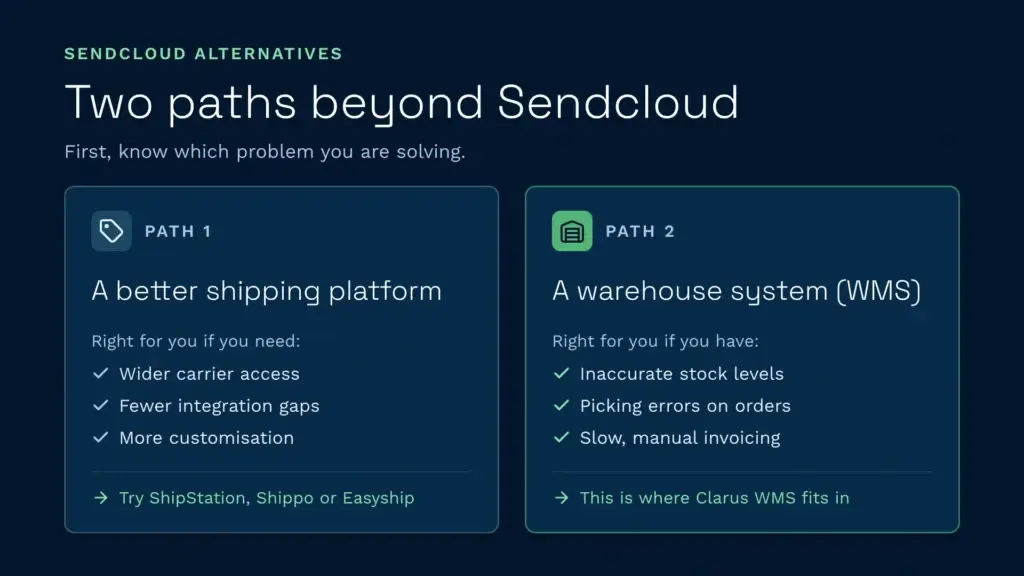
Sendcloud is a shipping and label management platform used by European ecommerce businesses to book carriers, print labels, and manage tracking and returns. If you’re considering a Sendcloud alternative, it’s worth being clear about the problem you’re trying to solve, because the answer splits into two very different paths.
Opción 1: Quieres una plataforma de etiquetas de envío mejor. If Sendcloud’s limitation is carrier access, integration gaps or lack of customisation, other label-and-tracking platforms like ShipStation, Shippo or Easyship might fit better. This is where most Sendcloud alternatives live.
Path 2: You’ve hit a ceiling no shipping platform can fix. If your frustration isn’t with labels but with stock accuracy, slow invoicing, picking errors, or managing several customers’ inventory in one warehouse, the bottleneck is inside the warehouse, not at the label printer. That’s where a warehouse management system (WMS) comes in, and it’s the problem Clarus WMS is built for.
This guide covers both paths honestly. If you’re shopping for a shipping platform, you’ll find fair reviews of the main alternatives. If your challenge is warehouse operations, you’ll see why a label tool can only solve half the problem.
Comparación rápida: Sendcloud y las principales alternativas
| Plataforma | Mejor para | Multicliente / 3PL | Número de portadores | Alcance mundial |
|---|---|---|---|---|
| Sendcloud | Comercio electrónico europeo, automatización del etiquetado | No | Más de 170 (Crecimiento+) | Solo para Europa |
| ShipStation | Pymes que operan en múltiples plataformas de venta, de 500 a 10 000 pedidos al mes | Limitado | 100+ | Una opción sólida en EE. UU. y a nivel mundial |
| Shippo | Startups, desarrolladores, menos de 2.000 pedidos al mes | No | 100+ | Global |
| Easyship | Transacciones transfronterizas a nivel mundial, de 100 a 5.000 pedidos al mes | No | Más de 550 repartidores | Especialista a nivel mundial |
| nShift | Empresa, más de 10 000 pedidos al mes, varios almacenes | Limitado | 170+ | Global |
| Clarus WMS | Almacenes 3PL y multicliente: control total | Sí, multicliente nativo | Más de 70 transportistas integrados (Royal Mail, DHL, DPD, Evri, UPS, FedEx, GLS) | Reino Unido, Irlanda, Benelux, Francia, Italia, Alemania, Canadá, Australia |
¿Qué es Sendcloud y para qué sirve realmente?
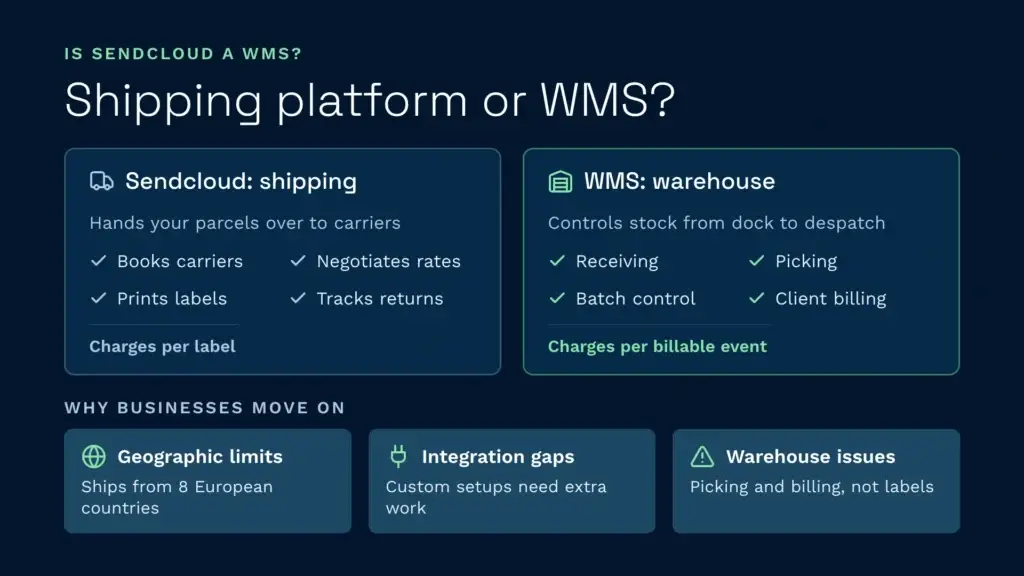
Sendcloud isn’t a warehouse management system. It’s a shipping and post-purchase platform. A shipping platform books carriers, provides shipping rates, generates labels, and manages branded tracking and return portals. That’s what Sendcloud does, and it does it well for European businesses.
A shipping platform doesn’t run receiving, putaway, picking, pack logic, inventory locations, batch and lot control o multi-client billing. Those are warehouse operations. If your inventory is held on a spreadsheet, if stock accuracy sits at 85% because picks are checked by eye instead of by scan, or if invoicing takes three people a week to reconcile, a better label printer won’t fix it.
Sendcloud holds a 4.5 rating on G2 from more than 150 reviews.
Why businesses leave Sendcloud
Sendcloud users tend to move for one of three reasons.
Where you can ship from. Sendcloud is fully supported for shipping from the UK, Austria, Belgium, France, Germany, Italy, the Netherlands and Spain. Czechia, Denmark, Poland, Portugal and Sweden are available if you have a local invoice address and your own courier contract. You can send parcels worldwide from those countries, but if you open fulfilment sites in North America, Asia or Australia, you’ll need a platform built to ship from there. ShipStation and Easyship both cover a wider set of origin countries and carriers outside Europe.
Lagunas de integración a gran escala. Sendcloud lists 100+ plug-and-play integrations with shop systems, marketplaces, WMS and ERPs. But businesses with custom fulfilment workflows or complex multi-warehouse operations can find the out-of-the-box setup restrictive, and the workaround is custom development or manual intervention. Clarus connects natively to the main ecommerce platforms, marketplaces and carriers, and has an API for anything custom.
A warehouse problem that looks like a shipping problem. This is the one people miss. A business runs Sendcloud for labels but loses orders to picking errors, spends four days a month on manual billing reconciliation, or can’t tell which customer’s inventory is in which location. They assume they need a better shipping platform. What they actually need is visibility and control inside the warehouse. Sendcloud can’t give them that, and no label platform can.
¿Sendcloud es un sistema de gestión de almacenes (WMS)?
No. Sendcloud is a shipping and post-purchase platform. It generates labels and tracks parcels. A warehouse management system is the operational control layer for stock movement: receiving, putaway, replenishment, picking, packing and despatch. They’re adjacent but separate jobs. Many businesses use both: a WMS to run the warehouse, and a shipping tool to hand off to carriers. Our guide to software de gestión de envíos covers that carrier side in more detail.
For a 3PL or multi-client warehouse, the split matters even more. A WMS has to bill by client, keep each client’s data separate, and track activity-based charges such as storage, picks and value-added services. Sendcloud charges you per label. A 3PL WMS records every billable event so you can charge your own clients for the work. The two don’t overlap.
Sendcloud frente a ShipStation: diferencias clave
ShipStation is a multi-carrier shipping and order management platform with 400+ integrations, including more than 200 parcel carriers. It started in the US and also runs a UK service with carriers such as Royal Mail, Yodel and DPD. It connects to Amazon, eBay, Shopify, Etsy and others, and like Sendcloud, it prints labels, manages tracking and handles returns.
The choice between them comes down to geography and complexity. Sendcloud makes sense if you ship mainly from Europe and want a lightweight, intuitive tool. ShipStation makes sense if you sell across several marketplaces, ship from North America as well as the UK, or want more automation rules and batch processing. Neither is a warehouse system. ShipStation includes inventory management and sells fulfilment and 3PL add-ons, but both are built around orders and labels rather than putaway, location control and scan-verified picking.
Lista de alternativas a Sendcloud, por caso de uso
La mejor opción de envío en general: ShipStation
ShipStation is the most direct Sendcloud replacement for multi-marketplace sellers in the UK and US. It automates label generation at scale across a wide range of channels and carriers. Precios is a tiered monthly subscription based on how many shipments you send, with a free trial.
Where it falls short: ShipStation is a shipping and order platform, not a warehouse system. If your warehouse runs on paper pick lists, or you invoice customers for storage and handling by hand, ShipStation won’t solve that.
La mejor opción para envíos internacionales: Easyship
Easyship is built for cross-border shipping, with access to 550+ courier services and automatic calculation of import tax, duties and tariffs at checkout. It suits ecommerce brands shipping to many countries.
Where it falls short: Easyship is a rate-shopping and label tool. It doesn’t manage inventory or billing. If you ship to 20 countries but hold stock in one warehouse, Easyship handles the carrier side well, but you still need a system to track what stock you have and where.
La mejor opción para desarrolladores y startups: Shippo
Shippo is a shipping platform and API with discounted rates across 40+ carriers. Its free Starter plan includes return labels, tracking and automations, and paid plans add branded tracking pages, notification emails and packing slips, plus the option to use your own carrier accounts. If you’re building custom fulfilment logic or want carriers inside your own software, Shippo’s API is a strong option.
Where it falls short: Shippo is a shipping layer. It doesn’t manage stock, warehouse locations or picking, so you’re responsible for everything that happens before the parcel is packed.
Ideal para operaciones de gran volumen con varios almacenes: nShift
nShift is a delivery management platform covering 1,000+ carrier services, with 450+ integrations including ERPs such as SAP, Microsoft Dynamics and NetSuite, plus WMS and order management systems. It runs the delivery journey from checkout through to returns, and its customer base leans towards large retailers.
Where it falls short: nShift is built for larger shippers, and pricing is quote-based. It’s also still a shipping platform, not a warehouse system. If you need inventory accuracy, pick validation or 3PL billing, nShift won’t provide it.
When Sendcloud isn’t the problem: the warehouse alternative
If your frustration with Sendcloud is really about the warehouse (slow invoicing, stock inaccuracy, picking errors, or managing several customers’ inventory), you need a WMS, not a better label tool.
Clarus WMS is a cloud-native warehouse management system built for Proveedores de servicios logísticos externos (3PL) and multi-client distributors. It isn’t a shipping platform and doesn’t compete with Sendcloud on rates or post-purchase tracking pages. Clarus is the system of record for what’s in your warehouse, where it is, who it belongs to and what you’ve done with it.
Here’s what Clarus does that Sendcloud can’t:
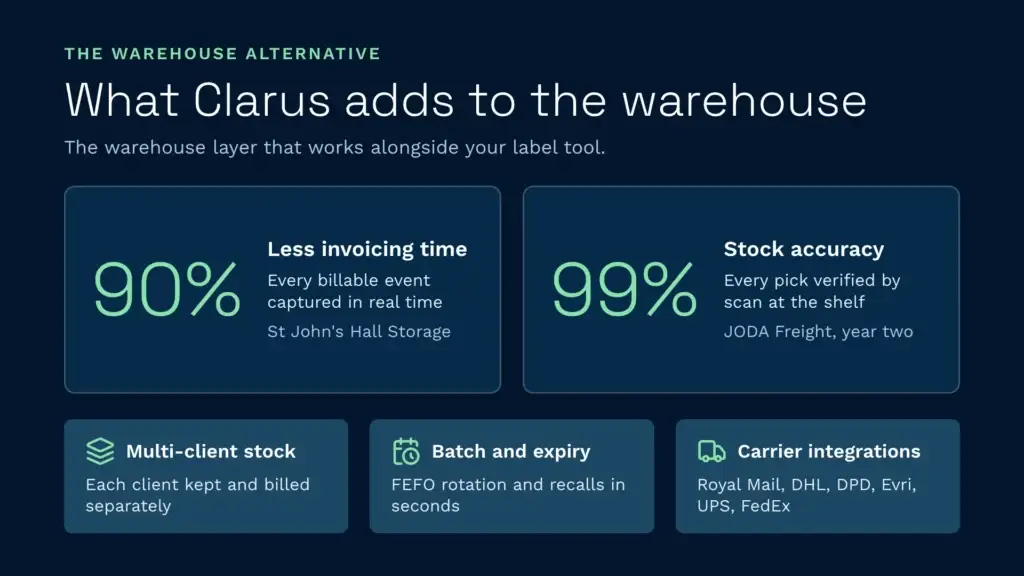
Segregación de existencias para múltiples clientes. Each client’s inventory, reporting and billing are kept separate within one system. A 3PL can store dozens of customers’ stock in one building and keep it all apart, and each client can see their own stock, orders and tracking through a branded portal. Sendcloud has no concept of this.
Facturación automatizada de 3PL. Clarus records every putaway, pick, pack, storage day, value-added service and return as the work happens, so you can bill each client for everything you did. Almacenamiento del Salón de San Juan cut its invoicing time by 90%. Its managing director used to spend around four days at the end of each month checking invoices by hand, and stopped once the Clarus data proved consistently accurate.
Scan-verified operations. With lectura de códigos de barras, GS1/EAN and location checks block mis-scans at the point they happen, and every pick is tied to a user and a timestamp. JODA Freight went from stock accuracy in the 90 to 97% range in its first year on Clarus to 99% by year two. Paper pick lists and end-of-line spot checks are where errors creep in, and that’s not something a label tool can touch.
Control de lotes y fechas de caducidad. Track fechas de vencimiento, números de serie and batches through the whole warehouse lifecycle. Clarus applies FEFO logic to stock movements and automatically locks expired lots from allocation. Campeys can now run a full traceability recall test in under five minutes. Sendcloud tracks labels and tracking numbers, which isn’t the same thing.
Native carrier integrations. Clarus connects directly to the UK and European carriers you’d expect, including Royal Mail, DHL, Correos del país, Evri, UPS, FedEx y GLS, and selects the carrier and service automatically based on order weight, value, postcode and destination. The Lista completa de integraciones is public. For many operations, that means the WMS handles the carrier handoff itself. If you’d rather keep a separate shipping platform, Sendcloud lists WMS among the systems it connects to, so ask both vendors whether the connection you need already exists.
Explicación de las tarifas de Sendcloud
Sendcloud publishes its precios. There’s a free plan capped at 20 parcels a month, limited to Sendcloud’s own shipping rates, and a 14-day free trial with no card required. Paid plans run from Lite to Pro, each with a monthly subscription plus a per-label fee, and higher tiers include more labels a year. Enterprise pricing is custom quoted.
Courier access is tiered too: the free plan gives you 70+ carriers, and 170+ open up from Lite upwards. If you plan to build against Sendcloud’s API, note that API v2 is entering maintenance mode, with its “Create a parcel” endpoint closed to new users, so new integrations should be built on v3. nShift’s side-by-side comparison flags the same change.
Clarus WMS precios starts from £1,000 a month, and it’s published rather than quoted on application. Implementation is a one-off fee, and a standard implementation goes live in around 12 weeks. Our Guía de costes de WMS breaks down what goes into the total.
Cómo migrar desde Sendcloud sin perder las tarifas de los transportistas
If you’re switching to another shipping platform (ShipStation, Shippo or Easyship), start with your carrier contracts. Rates you’ve negotiated directly with carriers are yours and can usually be connected to the new platform. Rates you’ve been using through Sendcloud’s own carrier deals stay with Sendcloud, so get comparable quotes before you switch. Then:
- List your carrier accounts, contracted rates and services in use.
- Test label generation and carrier connections on the new platform.
- Run both platforms side by side for a week to catch any label or tracking gaps.
- Repoint your shop integrations (Tienda virtual, WooCommerce and so on) to the new platform.
- Deja de utilizar Sendcloud una vez que se haya confirmado que el seguimiento y las devoluciones funcionan correctamente en el nuevo sistema.
If you’re moving to a WMS like Clarus, the process is different. You’re adding a warehouse layer that takes orders from your webshop, your 3PL customers or your ERP, manages inventory and picking, then books the carrier through its own carrier integrations. If you want to keep a separate shipping platform as well, confirm the connection with both vendors before you plan the cutover.
Sendcloud: el resumen sincero
Sendcloud is a solid European shipping platform for ecommerce businesses that want a lightweight label-and-tracking tool with good carrier access. Its 14-day trial (no card required) and free plan make it easy to test.
The reasons to move are clear: shipping from outside Europe, integration depth, customisation, or realising your real problem isn’t shipping but the warehouse.
If you ship globally, compare Easyship. If you sell on several marketplaces, ShipStation is more integrated. If you’re building custom fulfilment, Shippo’s API is the cleaner place to start. If stock accuracy is stuck at 85% despite your best efforts, if invoicing takes four days a month, or if you manage several customers’ inventory under one roof, no label platform will help. You need a WMS, and that’s where Clarus fits.
Habla con un experto en almacenes
If you’re weighing up your options and want to see how a purpose-built WMS works in practice, Clarus is worth a conversation. We work with Proveedores de servicios logísticos externos (3PL) and distributors across the UK to implement warehouse management software that fits the way you operate.
Ponte en contacto con nuestro equipo para discutir tus requisitos.