

Clarus WMS and SnapFulfil are both established cloud sistemas de gestión de almacenes used by UK 3PLs. But they take different approaches to multi-client billing, pricing and how much configuration a project needs. This comparison sets out the head-to-head detail so you can decide which is the right fit for your operation.
Quick verdict: which is best for you?
Choose SnapFulfil if: you run a highly automated site where SnapControl’s orchestration of robotics and automation systems is central, Gartner Magic Quadrant recognition is a procurement requirement, or you’re already invested in the Synergy ecosystem.
Elige Clarus si: you’re a growing 3PL adding clients quickly, want published pricing with no tie-ins, want billing captured automatically at source rather than rebuilt at month-end, need a self-service portal for each client, or work with clients on a wide mix of ecommerce platforms, ERPs and carriers.
Side-by-side comparison
[TABLE: Clarus WMS vs SnapFulfil comparison table to go here]
Clarus: cloud WMS built for scaling 3PLs
Clarus is a cloud-native warehouse management system built around multi-client 3PL work: stock segregated by client, billing captured automatically and a self-service view for every customer. It runs on ISO-certified AWS infrastructure, so there are no servers to maintain on site.
Puntos fuertes
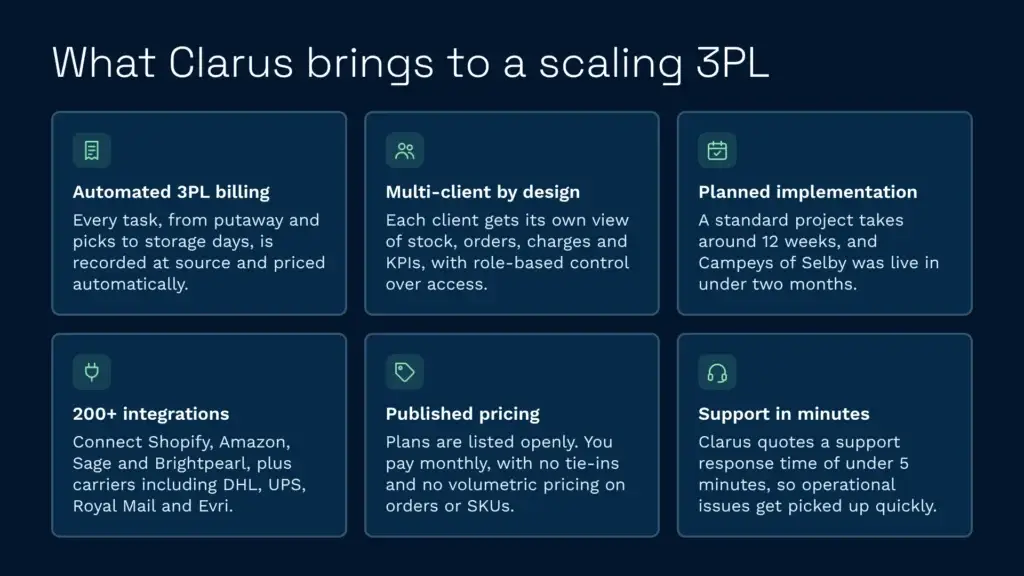
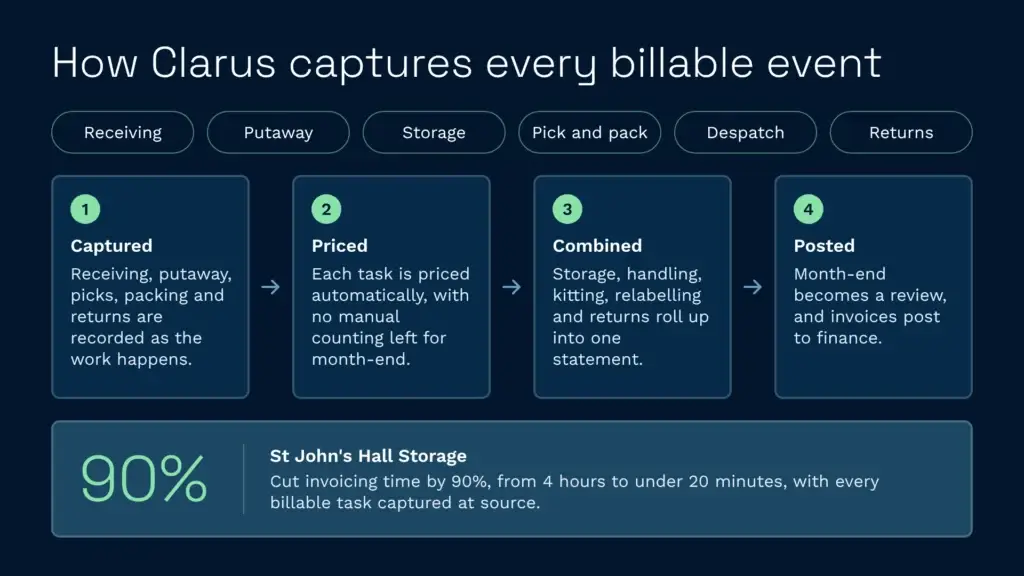
Facturación automatizada de 3PL Every task, from putaway, picks and packing to value-added services and storage days, is recorded at source and priced automatically through Clarus client billing. Month-end becomes a review, not a rebuild. Almacenamiento del Salón de San Juan cut its invoicing from 4 hours to under 20 minutes, a 90% reduction.
Multi-client by design: Each client gets its own view of stock, orders, charges and KPIs through customer self-service, with tenant-isolated views and role-based control over what each user sees. Orders, SKUs, locations and carriers are unlimited, so taking on a new client doesn’t bring volumetric charges.
Predictable implementation: A standard project typically takes around 12 weeks. Los Campeys de Selby went live in under two months, and KATEM Logística went on to scale its monthly picks 10x after go-live.
Más de 200 integraciones: Clarus connects to over 200 systems, including Tienda virtual, WooCommerce, BigCommerce, Envíos de Amazon, eBay, Sage and Brightpearl. Carriers include DHL, UPS, FedEx, Royal Mail, Correos del país, Evri y TNT. There are also TMS platforms such as Qargo y Maxoptra, and pallet networks including Palletforce y La red de palés. You can say yes to almost any client tech stack. See the full integrations library.
Published pricing: Plans are listed openly on the Página de precios de Clarus, from a Core tier for single-site operations to a Scale tier for 3PLs and multi-site distributors. You pay monthly with no tie-ins, and there’s no volumetric pricing on orders or SKUs. Your final quote covers user licensing and a one-off implementation fee, so you know the full cost up front.
Asistencia rápida: Clarus quotes a support response time of under 5 minutes, so you’re not left waiting on an operational issue.
Casos en los que Clarus podría no ser la mejor opción
If you run a single very large client operation that needs deep enterprise-level configuration, a WMS built for that model may suit you better than a multi-client cloud platform.
If you need to orchestrate conveyors, robotics and other automation at scale from your WMS, SnapFulfil’s SnapControl is more established in that space.
If Gartner Magic Quadrant positioning is a procurement requirement, Clarus isn’t currently included.
Real results: JODA Freight moved its stock management off an Excel database, reached 99% stock accuracy in its second year on Clarus and cut stock takes from several weeks to one day. MSD (Mitchell Storage & Distribution) cut warehouse admin by 60% and opened up new revenue streams. Los Campeys de Selby achieved sub-5-minute recall tests and BRC Double-A accreditation.
SnapFulfil: established cloud WMS with automation orchestration
SnapFulfil is a cloud WMS from Synergy Logistics, which was founded in 1972 and has more than 50 years in warehouse software. SnapFulfil was built for the web in 2007 and serves ecommerce, D2C and 3PL warehouses, with offices in the UK and North America.
Puntos fuertes
Gartner recognition: Synergy was included in the 2025 Gartner Magic Quadrant for Warehouse Management Systems for the 13th time, as a Niche Player. That carries weight in enterprise procurement.
SnapControl automation orchestration: SnapControl coordinates automation devices and robotic systems centrally from one platform, and it’s designed to be device and technology agnostic. If you’re running a highly automated distribution centre, it’s a proven option.
Long track record: Synergy’s warehouse software has been in use for decades, and its earlier system ran in large distribution centres in the 1990s.
3PL billing module: SnapFulfil’s billing module supports tiered rates, pick surcharges, storage charged by location or volume, and value-added services recorded on RF devices.
Fast standard deployment: SnapFulfil advertises deployment in 45 days or less for its rapid deployment option.
Limitaciones
Personalización: Reviewers on Capterra often say changes need vendor tickets or custom work, which adds cost and delay. One reviewer reports that unmet requirements took more than a year to resolve after go-live.
User-based costs: SnapFulfil says customers pay for extra users as they need them, so a growing team feeds directly into cost. Capital purchase and leasing options are available.
Support response: Capterra reviewers rate SnapFulfil’s customer service 4.1 out of 5, and several say responses sometimes take longer than they’d like, particularly for tickets raised outside business hours. One notes that 24/7 support costs extra.
Cloud architecture and deployment: what matters in practice
Both platforms are cloud-based, so neither needs servers on site. The difference is in how much configuration each new client brings.
Clarus is built around client accounts, rate cards and client portals as standard. Adding a client follows a repeatable path rather than a fresh project, which matters when you’re onboarding several clients a year.
SnapFulfil can be configured closely to your warehouse layout and workflows, which is powerful for complex sites. But reviewers note that changes beyond the standard set often go through vendor tickets, so it’s worth asking how a new client’s requirements would be handled before you sign.
Multi-client billing: the clearest differentiator
This is where the difference becomes operational reality. A 3PL’s core business problem is knowing exactly what to invoice each client at month-end: storage charges, per-pick fees, packing labour, returns handling and value-added services. Every missed billable event is lost revenue.
Clarus records every task at source and prices it automatically: receiving, putaway, every night in storage, every pick and pack, every despatch and every return. Storage, handling, kitting, relabelling and returns roll up into one statement, ad-hoc charges can be added with reference attachments, and approved invoices post straight to your finance system. That’s how Almacenamiento del Salón de San Juan went from 4 hours of invoicing to under 20 minutes.
SnapFulfil’s billing module covers a wide range of charge types too. So when you compare the two, ask each vendor to show you a real month-end close: how much is captured automatically, and how much your team still has to check and rebuild by hand.
If billing reconciliation is eating hours of your team’s month, a 3PL billing audit is a quick way to see where charges are slipping through.
Integrations and ecosystem
Clarus connects to over 200 systems across ecommerce (Tienda virtual, Envíos de Amazon, eBay, WooCommerce, BigCommerce), carriers (DHL, UPS, FedEx, Royal Mail, Correos del país, Evri, TNT), ERPs and accounting (Sage, Brightpearl), TMS platforms (Qargo, Maxoptra) and pallet networks (Palletforce, La red de palés).
SnapFulfil also offers integrations, though it doesn’t publish a full count, so ask for the list that covers your clients’ systems. Clarus’s breadth means you can onboard a Shopify brand and a food distributor on Sage in the same month using standard connectors, without custom development.
Cronograma de implementación
Clarus: around 12 weeks for a typical project. The multi-client setup is already built in, so data mapping and client onboarding follow a predictable path, with time allowed for training and testing. Los Campeys de Selby was live in under two months.
SnapFulfil: advertises deployment in 45 days or less for its rapid deployment option. More complex projects will depend on scope, and reviewers mention that changes after go-live can be slow to land.
Whichever you’re evaluating, ask for a dated plan that covers your specific clients, integrations and billing rules. If a new client is waiting or your current system is creaking, a timeline you can plan a business around matters more than a headline figure.
Support and responsiveness
Clarus: quotes a support response time of under 5 minutes, so operational issues get picked up quickly.
SnapFulfil: offers 24/7 critical cover and flexible service level agreements. Capterra reviewers rate its customer service 4.1 out of 5, with some noting slower responses outside business hours. If you’re running a 24/7 operation, check exactly what your support level includes.
Who should choose which?
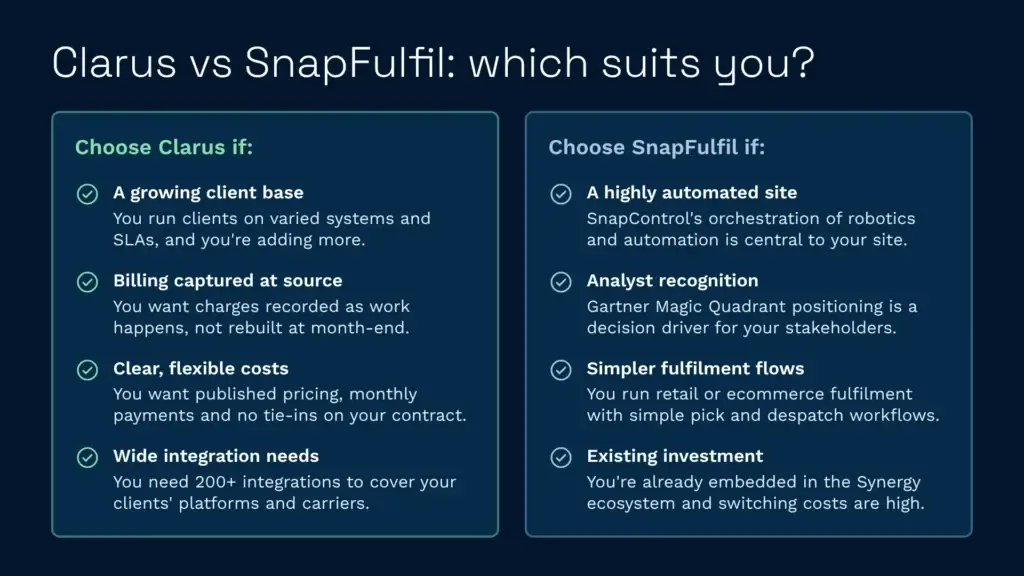
Clarus is the right choice if:
- You’re a 3PL managing several mid-sized clients with different tech stacks and SLAs, and you’re adding more.
- You’re spending significant time on manual billing reconciliation and want charges captured at source.
- You want published pricing, monthly payments and no tie-ins.
- You need 200+ integrations to support a wide mix of client systems.
- You want a self-service portal for every client, so they stop emailing for updates.
- You want a cloud-native platform with no servers to maintain.
SnapFulfil is the right choice if:
- You run a highly automated distribution centre where SnapControl’s orchestration of robotics and automation is essential.
- Gartner positioning or analyst recognition is a decision driver for your stakeholders.
- You’re a retail or ecommerce fulfilment operation with relatively simple pick and despatch workflows.
- You’re already embedded in Synergy’s ecosystem and the switching cost is too high.
Migration: how difficult is the switch?
If you’re currently on SnapFulfil and considering Clarus, the switch is manageable but needs planning. You’ll need to:
- Export your master data (SKUs, locations, clients, carrier profiles).
- Map your billing rules to Clarus’s automated client billing.
- Migrate open stock balances (typically a month-end snapshot).
- Reconnect your integraciones.
- Set up client portals and share the new access with your clients.
- Train your team on the Clarus interface.
The Clarus solutions team guides you through each step, and a typical project takes around 12 weeks.
Habla con un experto en almacenes
If you’re evaluating your options and want to see how a WMS built for 3PLs works in practice, Clarus is worth a conversation. We work with 3PLs and distributors to implement warehouse management software that fits the way you operate, not the other way around.
Ponte en contacto con nuestro equipo para discutir tus requisitos.