

Warehouse management system ROI is the net financial gain a WMS produces, divided by what it costs, over a fixed period, usually three years. To calculate it, add up every cost of buying and running the system, add up the benefits you can measure against today’s baseline, then apply the formula: (total benefits minus total costs) divided by total costs. The arithmetic is simple. The hard part is the inputs, because a finance director will test every one of them. This guide covers the formula, the costs, the benefits you can and can’t put a number on, the payback period, and how to turn the result into a business case that gets signed.
What is warehouse management system ROI?
Warehouse management system ROI is a percentage that shows how much money a warehouse management system returns for every pound spent on it. An ROI of 60% over three years means that, after the system has paid for itself, it has returned a further 60p for each pound of cost.
Three measures usually sit side by side in a WMS business case:
- Return on investment: (total benefits minus total costs) divided by total costs, shown as a percentage over a stated period.
- Payback period: the point at which cumulative benefits overtake cumulative costs. It answers “when do we get our money back?”
- Net present value: the same cash flows, discounted so that money arriving in year three counts for less than money arriving today.
These are standard investment appraisal methods, not warehouse-specific ones. HM Treasury’s Green Book sets out how the UK government discounts future costs and benefits, and it is a useful public reference even for a private business. ICAEW’s investment appraisal resources cover the same ground from the accountant’s side. If your finance team already has a house method for appraising capital projects, use theirs. A WMS case that follows the same template as the last forklift purchase is far easier to approve.
One more idea is worth borrowing from the public sector. The Treasury’s business case guidance requires every option to be compared against “business as usual”. That matters here because the real alternative to a new WMS is rarely a rival system. It’s carrying on with the spreadsheet or the legacy software you already have. Doing nothing has a cost too, and your ROI analysis for a WMS should price it.
How to calculate WMS ROI in five steps
Calculating warehouse management system ROI follows the same sequence whether you run one shed or ten.
- Fix the period. Three years is common for subscription software. Pick one period and use it for every number.
- Gather the baseline. Measure today’s performance before you talk to any vendor: labour hours by activity, pick error rates, stock write-offs, days spent on stock takes, hours spent on admin and invoicing. Without a baseline, every benefit is a guess.
- List every cost. One-off costs and running costs, including your own team’s time.
- Value the benefits. Take each measurable improvement, convert it to pounds per year, then phase it in. Benefits don’t arrive in full on day one.
- Run the formula and test it. Calculate ROI and payback, then cut the benefits by a quarter and see whether the case still stands.
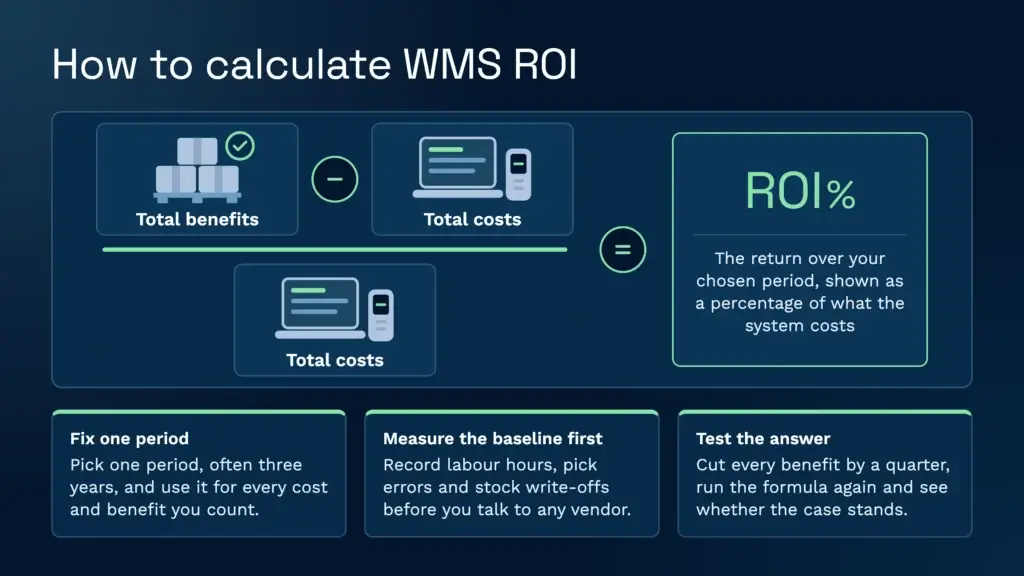
A spreadsheet is all you need. Any WMS ROI calculator, whether you build it or a vendor hands it to you, is only as good as the baseline you put in. If the calculator arrives with the improvement percentages already filled in, replace them with your own.
What costs go into the calculation?
Cost is the easier half of the warehouse management system ROI sum, but it’s often undercounted. Procurement teams call the full picture total cost of ownership, a concept the Chartered Institute of Procurement and Supply teaches as standard practice: count what you pay over the life of the purchase, not only the price on the quote.
For a WMS, that means five groups of cost:
- Licence or subscription: the recurring software fee, and what drives it (users, sites, modules, transaction volume).
- Hardware: handheld scanners, label printers, and any wifi upgrade needed to cover the racking.
- Aplicación: configuration, integrations, data migration and testing.
- Formación: vendor sessions plus the hours your operatives spend off the floor.
- Internal time: the project lead, the super users, and the manager who signs off each process. This is the line most often left out.
We won’t repeat price ranges here. Our guide to Coste del SGA breaks down what each of these typically involves, and Clarus publishes its own precios. For the project effort itself, the Guía de implementación de WMS shows where internal time goes.
Which benefits can be measured, and which are harder to put a number on?
In a warehouse management system ROI model, the benefits you can defend are the ones tied to a number you already record. The table below lists the main categories, the baseline to gather for each, and how to turn the improvement into pounds.
| Benefit | Baseline to gather | How to value it | Hard or soft |
|---|---|---|---|
| Productividad laboral | Lines picked per labour hour, overtime and agency hours | Hours saved × loaded hourly cost | Hard, if the hours leave the rota |
| Precisión en la preparación de pedidos | Mis-picks per 1,000 lines, credit notes, redelivery cost | Errors avoided × cost per error | Hard |
| Precisión del inventario | Write-offs, count variance, days spent on stock takes | Write-offs avoided plus count hours saved | Hard |
| Space utilisation | Occupied against available locations, overflow storage spend | External storage avoided, or revenue from freed space | Hard only if space is sold or released |
| Admin and reporting | Hours spent re-keying, building reports, answering stock queries | Hours saved × loaded hourly cost | Hard if redeployed, otherwise soft |
| Billing capture (3PL) | Charges raised against activity done, days to invoice | Revenue recovered, cash received sooner | Hard |
| Customer retention | Complaints, service failures, accounts lost | Usually kept out of the headline figure | Soft |
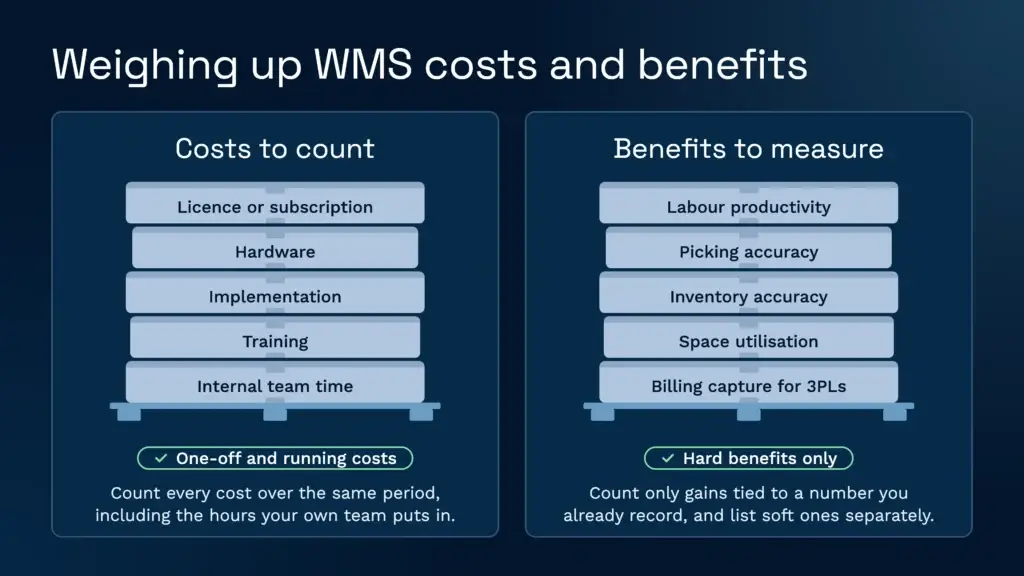
Hard benefits
Labour is normally the largest line. The saving comes from less walking, fewer searches for stock and less paperwork, and our guide to reducing labour costs with a WMS explains the mechanics. To price an hour, use what it costs you, not the headline wage. Start with your own payroll data, then add employer National Insurance at the rates HMRC publishes, pension and holiday cover. If you need an outside benchmark, the ONS Annual Survey of Hours and Earnings reports pay by occupation, and the legal floor is the National Living Wage.
Be strict about one thing. A labour saving is only hard if the hours leave the cost base: less overtime, fewer agency shifts, or growth absorbed without hiring. Ten minutes saved per picker per day that turns into ten more minutes of waiting is not a saving.
Error cost is the next most defensible. Each mis-pick carries a credit note, a second delivery, the labour to process the return and sometimes a customer penalty. Work out your own cost per error, then apply it to the errors a scan-verified process should remove. Our guide on how to reduce picking errors covers where they come from. Stock write-offs and count time work the same way, and the guide to improving inventory accuracy shows what moves the number.
Soft benefits
Some gains are real but resist a figure: staff who train faster, customers who stop ringing for stock levels, a tender you can now bid for. List them in the business case, describe them plainly, and leave them out of the warehouse management system ROI percentage. Mathew Buttar, Head of Solutions at Clarus WMS, was asked whether he could put a number on the uplift from training. His answer was “probably not”, because it depends on the capability of the people on site. That’s the right instinct. A soft benefit with an invented number attached weakens every hard number next to it.
How does WMS ROI differ for a 3PL?
For a 3PL, warehouse management system ROI has a revenue side that an own-stock warehouse doesn’t have. Two lines matter most.
Missed charges. A 3PL earns money from activity: pallets received, days stored, lines picked, labels applied, loads restacked. When that activity is recorded on paper or remembered at month end, some of it never reaches an invoice. To size the leak, take a sample month and compare the activity that happened on the floor with the charges you raised. The gap is your baseline. When you see a demo, ask the vendor to show exactly how a charge gets from a warehouse transaction to an invoice line, and which steps still need a person.
Invoicing speed. If someone spends days each month re-keying warehouse data into the accounts package and checking it, that’s measurable labour, and every day of delay is a day later you get paid. Almacén de St John’s Hall, a UK 3PL running Clarus WMS, cut its invoicing time by 90%. Before the change, the Managing Director spent around four days at the end of each month checking invoices that had been re-keyed from the old WMS into the accounts package. That re-keying has gone.
Clarus WMS is built for 3PL warehousing, so this commercial layer is where we’d expect a 3PL’s case to differ most from a generic one. If you run multiple clients, put billing and invoicing on their own lines in the model. They are often easier to prove than the labour saving.
A worked warehouse management system ROI example
This is an illustrative example. Every figure below is a made-up round number chosen to show the method. None of it is a Clarus customer result, a Clarus price or an industry benchmark.
Imagine a 3PL that expects one-off costs of £45,000 (implementation, hardware, training and internal time) and running costs of £35,000 a year. From its baseline, it estimates benefits worth £100,000 a year once the system is fully bedded in. It assumes only 40% of that arrives in year one, because part of the year is spent going live and the team is still learning.
| Illustrative figures | Year 1 | Year 2 | Year 3 | Three-year total |
|---|---|---|---|---|
| One-off costs | £45,000 | £0 | £0 | £45,000 |
| Running costs | £35,000 | £35,000 | £35,000 | £105,000 |
| Benefits realised | £40,000 | £100,000 | £100,000 | £240,000 |
| Net position for the year | Minus £40,000 | Plus £65,000 | Plus £65,000 | Plus £90,000 |
Three-year warehouse management system ROI in this example is (£240,000 minus £150,000) divided by £150,000, which is 60%. The project is £40,000 down at the end of year one and gains £65,000 in year two, so it breaks even roughly 19 to 20 months after the start.
Now look at what the same example does under different assumptions. Ignore ramp-up and count the full £100,000 in year one, and ROI jumps to 100%. Cut every benefit by a quarter, and it falls to 20%. Same system, same costs, three very different answers. That spread is why the assumptions deserve more of your time than the formula.
How long is the WMS payback period?
A WMS pays back when its cumulative benefits overtake its cumulative costs, and how long that takes depends on your baseline, your costs and how quickly the benefits ramp up. There is no reliable universal figure, so work out your own. You’ll find payback statistics quoted widely online. We haven’t repeated them because we couldn’t trace them to an independent, non-vendor source.
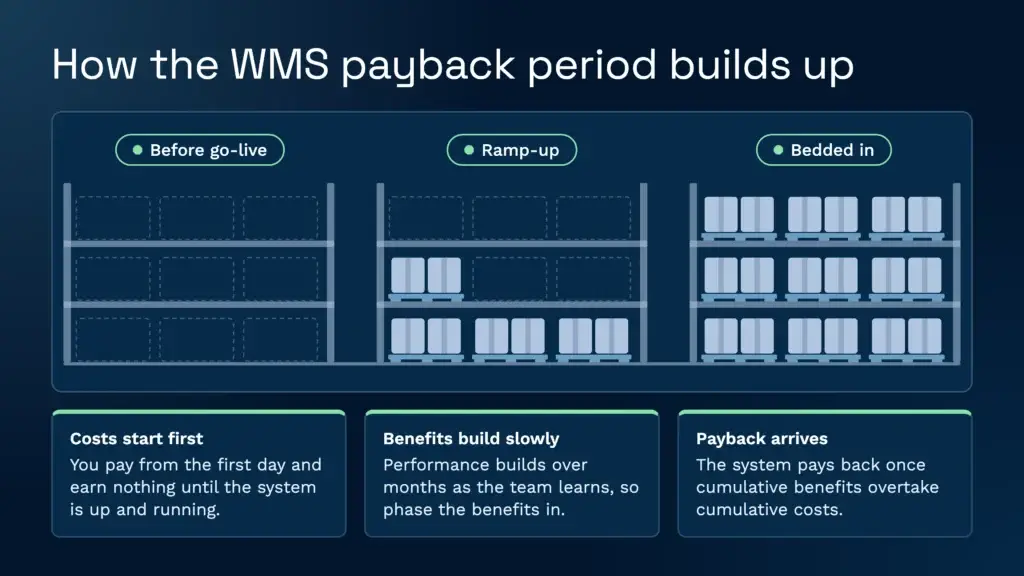
Two things set the WMS payback period more than anything else.
Time to go-live. You pay costs from the first day and earn nothing until the system is running. Mathew Buttar, Head of Solutions at Clarus WMS, gives the planning figure for a standard Clarus project: “A standard project with the correct support on both sides, we’d aim to get live within 12 weeks.” He adds that 12 weeks is a good standard “because you need to allow people time”. That figure applies to a standard, off-the-shelf implementation with no development work. Complex, multi-feature projects take longer, and your model should say which kind yours is.
Ramp-up after go-live. Performance builds over months. JODA Freight saw stock accuracy rise into the 90% to 97% range in its first year on Clarus WMS and reach 99% in year two. A business case that assumed 99% from the first month would have overstated year one.
Reviewing ROI after go-live
The ROI of a WMS implementation is a forecast until you check it, like any other projection. Re-measure the same baseline numbers at three, six and twelve months, using the same definitions. Where a benefit is behind, find out why. It’s usually a process the team has worked around, or master data that was never cleaned. A WMS amplifies the quality of the process underneath it, so poor labelling discipline before go-live becomes poor data after it. The review also gives finance something rare: evidence that a project delivered what its business case promised.
How to build a WMS business case a finance director will sign
A warehouse management system business case gets approved when the finance director can trace every number back to something they already trust. Structure helps. The Treasury guidance mentioned earlier tests a proposal on five questions: is there a strategic need, is it value for money, is the deal commercially sound, is it affordable, and can it be delivered. A two-page WMS business case that answers those five will cover most of what a board asks.
In practice:
- Lead with the cost of doing nothing. Show what the current errors, write-offs, overtime and missed charges cost per year.
- Source every baseline figure. Payroll, credit notes, the stock adjustment ledger, the agency invoice.
- Show three scenarios. Expected, cautious and worst case, each with ROI and payback.
- Separate hard from soft. Only hard benefits go in the headline.
- Name who owns each benefit. A saving with no owner rarely appears.
Common mistakes
The Green Book has a name for the most common one: optimism bias, the tendency of people proposing a project to overstate benefits and understate cost and time. In WMS cases it shows up in four ways. The same hour gets counted twice, once under picking and again under admin. Vendor averages stand in for your own baseline. Ramp-up is ignored, which in our example inflated ROI from 60% to 100%. And internal time is left off the cost side because nobody invoices for it. Trade bodies such as UKWA y CILT(UK) are good places to sense-check your assumptions with operators who’ve already been through it.
If you’d like to see how the numbers look from the finance side, Clarus has a page for finance teams evaluating a WMS.
Habla con un experto en almacenes
If you’re building a business case and want to see how a purpose-built WMS works in practice, Clarus is worth a conversation. We work with 3PLs and distributors to implement warehouse management software that fits the way you operate, not the other way around.
Ponte en contacto con nuestro equipo para discutir tus requisitos.