

If you’re evaluating warehouse management software and Infor WMS keeps coming up, you’ve probably heard about its labour management strengths and how well it scales. But does it fit your operation? For many 3PLs and UK-based distributors, the size of an enterprise platform, the length of its implementation and the cost of moving away later are reasons to look at newer, purpose-built alternatives. This guide covers what Infor WMS does well, where it may not suit you, and the best alternatives if you’re looking to switch or starting fresh.
Quick comparison: Infor WMS vs top alternatives
| Plataforma | Mejor para | 3PL multicliente | Facturación automática | Cloud/SaaS | UK support |
|---|---|---|---|---|---|
| Clarus WMS | 3PLs and UK warehouses | Purpose-built multi-client | Billable work captured as it happens | Nativo de la nube, sin servidor | UK team, under 5 minute response |
| Infor WMS | Enterprise, labour-intensive, complex workflows | Multi-client operations | Activity-based 3PL billing | CloudSuite on AWS, on-premise roots | Check local coverage |
| Mintsoft | Growing DTC brands, omnichannel, small to mid-sized 3PLs | Multi-client and multi-warehouse | Client invoicing for storage, handling and shipping | SaaS | UK-based |
| Snapfulfil | High-volume, complex pick paths, labour optimisation | 3PL module available | 3PL billing module | SaaS | UK support available |
| Deposco | Ecommerce fulfilment, 3PL scale | Multi-client with 3PL client portal | Ask about billing scope | SaaS | US company, UK office in London |
What is Infor WMS?
Infor WMS (marketed as Infor CloudSuite WMS) is an enterprise warehouse management platform. It combines core WMS functions with labour management, task management and 3PL billing. Gartner has named Infor a Leader in its Magic Quadrant for Warehouse Management Systems eight times in a row, most recently in April 2026. It’s built to handle complex warehouse layouts and a wide range of picking workflows. Infor started out on-premise and now runs CloudSuite WMS on AWS, with multi-tenant and single-tenant options. Its design still reflects its enterprise background.
Its main strengths are labour and task management, RF (radio frequency) and voice processing, multi-channel order handling (B2B and B2C), and integration with Infor’s wider supply chain suite. If your operation is large, labour-heavy and runs complex workflows with dozens of variations, Infor has the tools to model that.
Infor WMS: strengths and limitations
What Infor WMS does well
- Labour management: Task-based picking, wave management and labour tracking are built deep into the system. It suits operations where labour use and picking efficiency drive most of the cost.
- Warehouse complexity: If your warehouse has unusual layouts, several zoning strategies or highly customised pick routines, Infor can be configured to match them.
- Profundidad de integración: Alongside other Infor applications (ERP, supply chain planning), it shares data models and connects closely.
- Maturity: Infor has decades of development behind it and is proven at enterprise scale.
Where Infor WMS can struggle
- Implementation time and cost: Infor WMS rollouts typically take 9 to 18 months, and phased rollouts are common. Going live is a major capital project, not an operational decision you can easily reverse.
- Fit for smaller multi-client 3PLs: Infor includes multi-client operations and activity-based 3PL billing, but they sit inside a large enterprise platform. If you’re a small to mid-sized 3PL, find out how much configuration each new client needs, and whether a client-facing portal comes as standard or has to be built.
- Lock-in and vendor dependency: Once Infor is deployed, your operations are tightly tied to it and your staff training is specialised. Moving to another system is expensive and disruptive, and you can’t easily trial an alternative without running a parallel implementation.
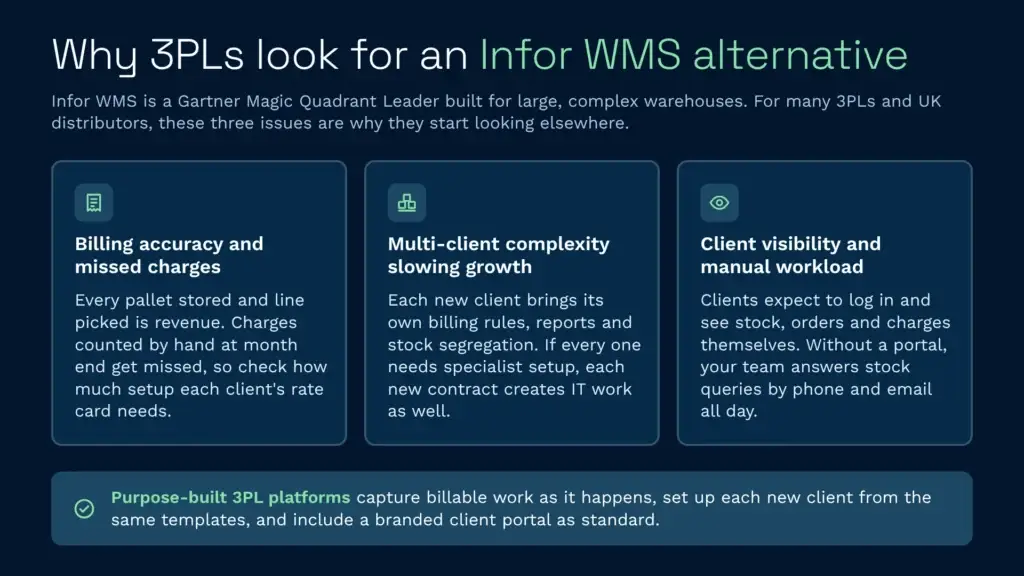
Why companies look for an Infor WMS alternative
The most common reasons 3PLs and UK distributors look at alternatives fall into three areas.
Billing accuracy and missed charges
For a 3PL, every pallet stored, line picked and job relabelled is revenue. If charges are counted by hand at month end, some will be missed. Infor does include activity-based 3PL billing, so the question is how much setup each client’s rate card needs and who maintains it. Purpose-built alternatives like Clarus capture billable work as it happens, including storage, handling, picking, packing, labelling, returns and value-added services, and price it automatically. Almacenamiento del Salón de San Juan, a UK third-party warehousing provider, cut its invoicing time by 90% after switching and saves the equivalent of about two staff members on site.
Multi-client complexity slowing growth
Every new client brings its own billing rules, reporting views and stock segregation needs. If each one needs specialist configuration, winning new contracts creates work for your IT team as well as your warehouse. 3PL-first platforms are built to run many clients in one warehouse, with stock segregation, billing rules and portal access set up per client from the same templates, so onboarding a new account is quicker.
Client visibility demands and manual workload
Modern clients, especially in ecommerce, expect to log in and see their stock, orders and charges for themselves. Without a portal, 3PLs end up answering “how much stock have I got?” by phone and email all day. When MSD gave clients that visibility through Clarus, those calls and emails dropped by about 60%. Purpose-built alternatives include a branded client portal as standard.
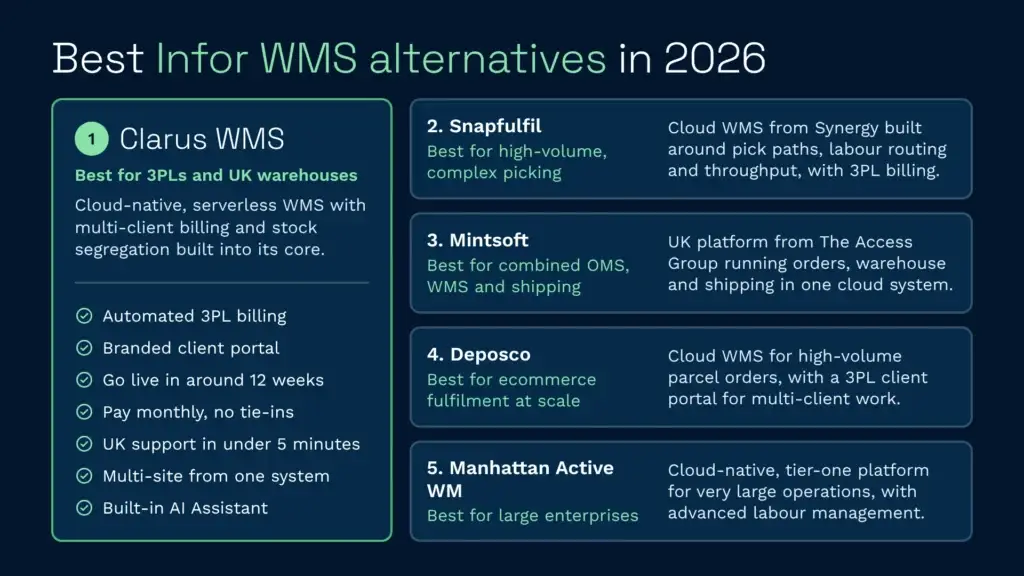
Best Infor WMS alternatives in 2026
1. Clarus WMS: best for 3PLs and UK warehouses
Clarus WMS is a cloud-native, serverless warehouse management system built for 3PLs, wholesale distributors and multi-client operations. Multi-client billing and stock segregation are part of its core design, not a module added to an enterprise system.
What makes Clarus a strong fit
- Purpose-built for 3PL: Multi-client stock segregation, automated 3PL billing y client self-service are all native. Each client’s inventory, reporting and charges are kept separate within one warehouse environment.
- Facturación automatizada de 3PL Storage, handling, picking, packing, labelling, returns and value-added work are recorded at source and priced automatically, with no manual counting. MSD cut its admin workload by 60% and turned cross-docking into a reliable revenue stream.
- Precisión del inventario: JODA Freight reached 99% stock accuracy by its second year on Clarus, and its stock takes went from weeks to one day.
- Cloud-native, no server maintenance: Clarus is cloud-native and serverless, and updates roll out automatically. There are no version upgrades to plan, no servers to patch and no infrastructure of your own to run.
- Implementation in weeks, not years: A standard, off-the-shelf project aims to go live within 12 weeks. Complex projects take longer. KATEM Logística went live for its first urgent customer within weeks.
- Multi-warehouse from one system: You can manage multiple sites, zonas de temperatura, existencias en depósito aduanero y hazardous goods from one interface. Picking por oleada, FIFO and FEFO rotation y registro de números de serie are built in.
- Client self-service portal: A branded portal where clients see real-time stock, order status, shipments and charges, with access configurable for each client.
- AI Assistant: El Asistente de IA Clarus reads operational data, carries out tasks in the system and flags bottlenecks.
- Cost and contract terms: Plans start from £1,000 a month, plus tiered user licensing and a one-off implementation fee. There are no tie-ins, and you pay monthly.
- Apoyo A UK-based team, with support response times under five minutes.
Where Clarus may not fit
- Bespoke labour management workflows: Labour task management is Infor’s strongest differentiator. If you rely on highly specialised picking strategies, such as complex voice-directed kitting workflows, you may need deeper task customisation.
Proof points
Clarus customer stories include KATEM Logística (monthly picks up 10x), Almacenamiento del Salón de San Juan (invoicing time cut by 90%), Transporte perimetral (99%+ stock accuracy with full food traceability) and Campeys (product recall tests in under five minutes). You can read more in Clarus customer stories.
2. Snapfulfil: best for high-volume, complex picking
Snapfulfil is a cloud-based WMS from Synergy, built for high-volume ecommerce and omnichannel fulfilment. Its strength is optimising the physical warehouse: pick paths, labour routing and throughput.
Puntos fuertes
- Wave picking and optimised pick-path routing.
- Real-time inventory visibility and multi-location management.
- Multi-client support for 3PL operations.
- Facturación de 3PL covering storage, value-added services, surcharges and pass-through costs.
Limitaciones
- Pricing is quote-based: There’s no published price, so you’ll need a custom quote for your scope.
- Best for high-volume picking: If you’re a smaller 3PL with varied clients and detailed billing rules, Snapfulfil’s main strength (picking optimisation) may not match your actual priorities. See how it compares in Snapfulfil vs Clarus.
3. Mintsoft: best for integrated OMS, WMS and shipping
Mintsoft is a UK cloud platform, now owned by The Access Group, that combines order management, warehouse management and shipping in one system. It’s especially strong for growing DTC (direct-to-consumer) brands and 3PLs handling omnichannel orders.
Puntos fuertes
- Combined OMS, WMS and shipping, so there’s no need to sync data between separate systems.
- Strong integrations with ecommerce platforms such as Shopify, WooCommerce, Amazon and eBay.
- Client invoicing for 3PLs based on storage, handling and shipping, plus a client portal.
- UK-based company with local support.
Limitaciones
- Built around ecommerce order flow: Its roots are in DTC and parcel fulfilment, so check how well it handles pallet-heavy, bonded or temperature-controlled work if that’s part of your mix.
- Pick optimisation is not its main focus: If you run thousands of picks a day and labour efficiency is your constraint, a picking-led system may suit you better. For a detailed look, see our Mintsoft alternative guide.
4. Deposco: best for ecommerce fulfilment at scale
Deposco is a cloud-based WMS built for ecommerce 3PLs and fulfilment centres handling high volumes of small-parcel orders.
Puntos fuertes
- Multi-client operations with a 3PL client portal covering inventory, orders and SLA performance.
- Deep integration with ecommerce platforms and carriers.
- Strong for parcel-volume, small-box workflows.
Limitaciones
- US-centric: Deposco is a US company with a UK office in London, so check what support hours and resources are available locally.
- Enterprise-level pricing: Pricing is quote-based and aimed at larger operations, so it may be harder to justify for small to mid-sized 3PLs.
- Not ideal for mixed warehouse types: If you handle palletised goods, temperature-controlled stock and small parcels, Deposco is designed mainly for the last of these.
5. Manhattan Active WM: enterprise alternative
Manhattan Active Warehouse Management is a tier-one, cloud-native platform built for high-volume retail distribution and large omnichannel fulfilment centres. It’s an enterprise option comparable to Infor in scope and cost.
Puntos fuertes
- Advanced picking optimisation and labour management for very large operations.
- Named a Leader in the Gartner Magic Quadrant for WMS for 17 years in a row.
- Proven in large retail distribution centres.
Limitaciones
- Enterprise pricing: Expect costs and implementation timelines in line with other tier-one platforms.
- Not suited to small and mid-sized 3PLs: The system is built for far larger operations than most 3PLs run.
- Lock-in: As with Infor, moving away is expensive and disruptive.
Cómo elegir: un marco de decisión
Ask yourself these questions
- How many clients do you serve, and do they have different billing rules? If you have five or more clients with different storage rates, pricing tiers and activity-based charges, you need 3PL billing that’s quick to set up per client. Clarus is built for this. With an enterprise platform, ask how much configuration each new client needs.
- Is labour optimisation your biggest constraint, or billing accuracy? Infor’s strength is labour. If you’re constrained by labour (picking speed, travel time), Infor or Snapfulfil are strong options. If billing is your constraint (missed charges, manual reconciliation), Clarus is the better fit.
- How quickly do you need to go live? A standard Clarus implementation aims for 12 weeks. Enterprise platforms like Infor commonly run for many months. Mid-market cloud platforms like Snapfulfil quote in weeks or months, so ask for the figure in writing. If time to value matters most, newer cloud platforms are the shorter route.
- What size is your operation? If you’re a small to mid-sized 3PL, a platform like Clarus is built around your needs. If you’re a very large logistics group, Infor or Manhattan may be more appropriate.
- Do your clients expect self-service visibility? Modern ecommerce and 3PL contracts often require clients to see stock, shipments and charges in real time. Clarus includes a branded client portal as standard, and so do several 3PL-focused platforms. With enterprise systems, check what’s included and what has to be built.
- How much vendor lock-in can you accept? If you want the freedom to change platforms without a year-long migration, pay-monthly cloud contracts with no tie-ins (Clarus) carry less risk than multi-year enterprise agreements.
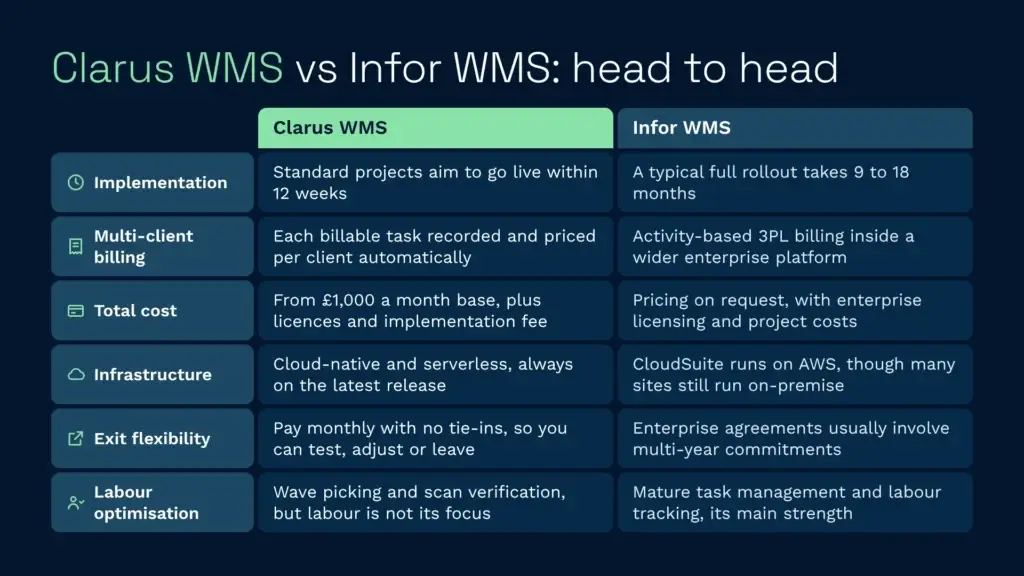
Clarus WMS vs Infor WMS: head to head
For a 3PL, the main differences are:
- Aplicación: A standard Clarus project aims to go live within 12 weeks, compared with 9 to 18 months for a typical Infor rollout. You see measurable business value within a quarter rather than a financial year.
- Facturación multicliente: Both include 3PL billing. Clarus records each billable task as it happens and prices it per client automatically, and was built around multi-client 3PL work from the start. Infor’s billing sits within a wider enterprise platform.
- Coste total de propiedad: Clarus starts from £1,000 a month base, plus user licensing and a one-off implementation fee, with no tie-ins. Infor pricing is on request, and enterprise WMS projects carry significant licensing, integration and implementation costs.
- Infrastructure: Clarus is cloud-native and serverless. Infor offers cloud deployment through CloudSuite on AWS, but many established Infor sites still run older on-premise or hosted versions.
- Exit flexibility: Clarus has no tie-ins, so you can test it, adjust and leave if it’s not working. Enterprise WMS agreements usually involve multi-year commitments.
- Labour optimisation: Infor’s task management and labour tracking are more mature. If labour is your constraint, Infor is stronger. Clarus includes wave picking and verificación del escaneo, but labour management is not its focus.
Integration and API support
Both platforms offer integrations, but they take different approaches:
- Clarus: Clarus has an Arquitectura centrada en las API with open connectivity through REST or GraphQL. It connects to over 200 systems, including Tienda virtual, WooCommerce, Envíos de Amazon, eBay, Sage 200, a wide range of shipping carriers and Qargo TMS. Its task-based design means warehouse activity is tracked in real time.
- Infor: Infor integrates deeply with other Infor applications (ERP, supply chain planning). Integrations with third-party systems often need custom API development, so it’s less plug-and-play than Clarus.
Infor WMS pricing and implementation
Infor doesn’t publish WMS pricing. When you’re getting quotes, ask about:
- Software licensing: This is usually based on user seats and modules.
- Aplicación: Costs depend on scope, customisation and deployment model. Typical timelines are 9 to 18 months for a full rollout.
- Condiciones del contrato: Check the minimum commitment and annual maintenance fees.
- Infrastructure: If you stay on-premise, server hardware, database licensing and ongoing IT support all add cost over the life of the system.
By comparison, Clarus pricing starts from £1,000 a month base, with tiered user licensing (the cost per user falls as you grow) and a one-off implementation fee, on pay-monthly terms with no tie-ins.
Habla con un experto en almacenes
If you’re weighing up your options and want to see how a purpose-built WMS works in practice, Clarus is worth a conversation. We work with 3PLs and distributors across the UK to implement warehouse management software that fits the way you operate, not the other way round.
Ponte en contacto con nuestro equipo para discutir tus requisitos.